
Table of Contents
- Why a Seasonal Tune-Up Matters More Than Ever in 2026
- How Often to Clean Air Conditioner Filters (and What Happens If You Don’t)
- Signs Your Air Conditioner Needs a Service
- DIY Air Conditioner Maintenance Tips You Can Do Safely
- The Air Conditioner Maintenance Checklist 2026: Month-by-Month Tasks
- Smart Home Integration, Error Codes, and Eco-Friendly Refrigerants
- When to Call a Licensed Technician (and Why It’s Worth It)
- Frequently Asked Questions
Last Updated: September 13, 2026
Why a Seasonal Tune-Up Matters More Than Ever in 2026
An air conditioner maintenance checklist is a scheduled set of inspection, cleaning, and testing tasks that keep a cooling system running efficiently and prevent breakdowns. Skipping it turns a small, cheap fix into a compressor replacement.
Energy efficiency standards have tightened, refrigerants have changed, and modern inverter systems are less forgiving of neglect than the old units many homes still run. A system that has drifted out of tune draws more power for the same cooling, and that shows up on every bill.
This guide from Airmelec covers what you can safely do yourself, what belongs with a licensed technician, and how to time each task across the year, a maintenance routine that holds up through a Hawkesbury summer.
A seasonal tune-up is not a luxury. It is the cheapest insurance you can buy against a mid-summer breakdown, and it typically costs far less than the repair it prevents.
How Often to Clean Air Conditioner Filters (and What Happens If You Don’t)
Clean or check your air conditioner filters every four weeks during heavy use, and at minimum every two to three months in lighter periods. It is the highest-impact task on the list, and it takes minutes.
A clogged filter restricts airflow: the evaporator coil ices up, the blower motor works harder, and cooling capacity drops while energy consumption climbs. In dusty or pet-heavy homes, filters load up faster than the calendar suggests, so check them visually rather than trusting the date.
- Split system indoor units: rinse reusable filters under lukewarm water, dry fully before refitting
- Ducted systems: check return-air filters monthly, replace disposable types as needed
- Replaceable filters: match the correct size and rating, and note the change date on the frame
A common mistake is refitting a damp filter. Trapped moisture encourages mould, which then blows straight into your living space.
Signs Your Air Conditioner Needs a Service
Book a service when you notice any of these warning signs, rather than waiting for a total failure, early signals are cheaper to resolve.
- Weak airflow from the vents despite the fan running at full
- Warm air, or cooling that takes far longer than it used to
- Strange noises: rattling, grinding, or a clicking that repeats
- Water pooling near the indoor unit or dripping from the ceiling
- Musty smells when the system starts
- Ice forming on the outdoor unit or refrigerant lines
- The system short-cycles, switching on and off rapidly
- Unexplained jumps in your energy bills
If two or more appear together, stop running the system and get it inspected. Continuing to operate a struggling unit can damage the compressor, the most expensive component to replace.
DIY Air Conditioner Maintenance Tips You Can Do Safely
Homeowners can safely handle the low-risk tasks: filter cleaning, outdoor debris clearance, drain flushing and visual inspections. Anything involving refrigerant, electrical wiring or gas is off-limits without a licence.
Before you start: isolate the power
Switch the system off at the isolator (the outdoor switch beside the condenser) and, where accessible, at the circuit breaker. This is not optional, the condenser fan can start without warning if the thermostat calls for cooling while you work. Wait a few minutes for the fan to stop.
Clear the outdoor unit
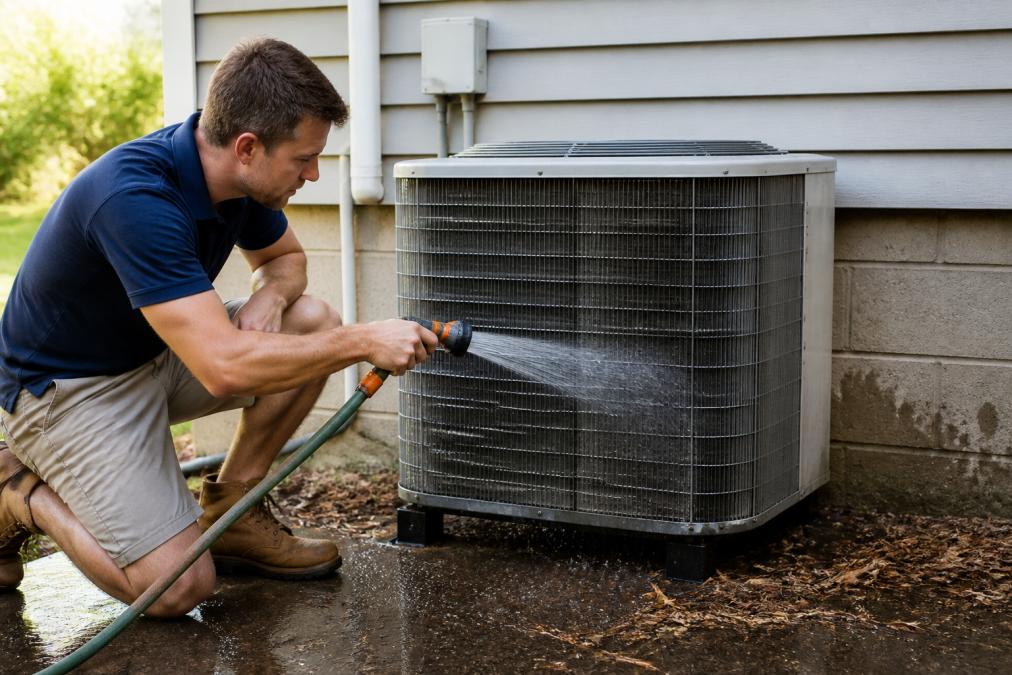
Start with the condenser. Clear leaves, grass clippings, cobwebs and nesting material from around and inside the cabinet, and keep at least half a metre of clear space on all sides so the unit can reject heat properly, a unit boxed in by shrubs or stored items runs hotter and draws more power.
Rinse the fins, gently
Rinse the fins with a garden hose from the inside out, so debris is pushed out rather than driven deeper into the coil. The fins bend easily, so avoid a high-pressure jet and never use a wire brush. A fin comb can straighten lightly crushed fins, but badly damaged coils are a technician job.
Flush the condensate drain
Find the drain line (usually a PVC pipe near the indoor unit or exiting the wall) and check the pan for standing water. Flush the line and, if you can reach it, clear the trap of slime or debris. A blocked drain is a common cause of water damage and float-switch shutdowns, and one of the easiest things to prevent.
Check the indoor unit
With the power off, open the front panel and inspect the evaporator coil for dust build-up or mould, wiping accessible surfaces with a damp cloth. Do not clean deep inside the coil, that requires coil cleaner and a technician who can protect the surrounding electronics.
Inspect, don’t disassemble
Walk the system and look for:
- Refrigerant lines with damaged insulation or oil residue (oil can indicate a leak)
- Rust, corrosion or water staining around the indoor or outdoor unit
- Loose panels, unusual vibration or debris inside the cabinet
- Thermostat reading that does not match a separate thermometer in the room
If you find any of these, note it down and stop. Visual inspection is safe; opening the electrical panel, handling refrigerant or bypassing a safety switch is not.
Never open the electrical panel or attempt to top up refrigerant yourself. Refrigerant handling is regulated, and the pressures involved can cause serious injury (Layer: Australian Marine Parks (ID: 0)). A DIY attempt here also voids most warranties.
A simple monthly routine
Monthly in peak season: check and rinse filters, clear debris from the outdoor unit, and glance at the drain pan. Quarterly: flush the drain line, check the thermostat against a separate thermometer, and walk the system for the warning signs above. Everything else belongs on the annual technician visit.
The Air Conditioner Maintenance Checklist 2026: Month-by-Month Tasks
The table below maps each task to a frequency and a skill level, so you can see at a glance what stays on your list and what goes to a technician.
| Task | Frequency | Who Does It |
|---|---|---|
| Clean or replace filters | Monthly in peak season | DIY |
| Clear debris from condenser unit | Monthly | DIY |
| Inspect and flush condensate drain | Quarterly | DIY |
| Check thermostat calibration | Quarterly | DIY |
| Clean evaporator and condenser coils | Annually | Technician |
| Test refrigerant charge | Annually | Technician |
| Inspect electrical connections and amperage draw | Annually | Technician |
| Lubricate blower motor and moving parts | Annually | Technician |
| Check ductwork for leaks and insulation | Annually | Technician |
Build the annual technician visit into early spring, before the first hot stretch, so you are not competing for an appointment when everyone else’s system fails at once.
Smart Home Integration, Error Codes, and Eco-Friendly Refrigerants
Most maintenance guides stop at cleaning. The bigger gains now sit in how your system is controlled, what it runs on, and what its own diagnostics are telling you.
Smart thermostats and automation
A smart thermostat turns a manual checklist into a self-monitoring routine. Modern units expose run-hours, filter-load estimates and fault history through their apps, and many push a notification when airflow drops or a sensor drifts. Set the following once and let the system police itself:
- Filter reminders based on actual run-hours rather than a calendar date, useful in dusty or pet-heavy homes where filters load faster than the calendar suggests
- Occupancy scheduling so cooling tracks when someone is actually home, rather than running flat out all day
- Zoning control on ducted systems, so unused rooms are not conditioned
- Fault alerts pushed to your phone the moment a code appears, before the system fails completely
If your unit predates smart controls, a plug-in thermostat or manufacturer bridge module is usually the cheapest efficiency upgrade available, often cheaper than a single service call.
Common error codes and what they point to
Error codes are the fastest way to tell a technician where to look before they arrive. Codes vary by brand, but the categories are consistent. Note the code down rather than clearing it, clearing erases the diagnostic trail.
| Code category | Typical meaning | Likely cause |
|---|---|---|
| Indoor/outdoor communication fault | Signal lost between units | Wiring, control board, or power interruption |
| Sensor fault (room or coil) | Temperature reading outside expected range | Failed thermistor or loose connector |
| Drain or float-switch fault | Condensate not clearing | Blocked drain line or full pan |
| Refrigerant or pressure fault | Charge outside operating range | Leak, undercharge, or restriction |
| Overcurrent or voltage fault | Compressor drawing too much current | Failing compressor, capacitor, or supply issue |
| Defrost or outdoor fan fault | Outdoor unit not cycling correctly | Fan motor, defrost sensor, or board |
A single code is a clue, not a diagnosis. Two or more appearing together usually point to a shared cause, often the control board or power supply, and that is when a licensed technician should be called.
Eco-friendly refrigerants and the 2026 transition
The refrigerant in your system is the other shift worth understanding. Older units commonly ran on high global-warming-potential (GWP) refrigerants, and the industry has moved toward lower-GWP alternatives with a much smaller climate impact. Newer systems are designed around these refrigerants, and the trade-offs are real:
- Recharge vs. upgrade: topping up an older system with a legacy refrigerant is increasingly expensive as supplies tighten, and it does nothing about the leak that caused the loss
- Compatibility: low-GWP refrigerants are not drop-in replacements, they often need different lubricants, seals and operating pressures, so a retrofit is rarely a simple swap
- Efficiency: newer units running low-GWP refrigerants typically achieve better efficiency ratings than the systems they replace, which is where the long-term saving sits
If your system still uses an older refrigerant, ask a technician to weigh a recharge against a full upgrade. In many cases the recharge is a stopgap, and the upgrade pays back through lower running costs.
Indoor air quality testing
Indoor air quality is where maintenance and health meet. Filters, drainage and ductwork all affect what you breathe, and a neglected system usually shows it in the air before the temperature. Watch for:
- Musty or damp smells on start-up, a sign of mould in the evaporator or drain pan
- Persistent dust despite clean filters, often a ductwork leak pulling in unfiltered air
- Humidity that never settles, a sign the system is short-cycling or oversized
- Allergy symptoms that worsen indoors, frequently linked to a dirty coil or blocked drain
A humidity meter and a visual check of the coil and drain pan will catch most problems early. If symptoms persist after a clean, a technician can test airflow and duct leakage to find the source.
When to Call a Licensed Technician (and Why It’s Worth It)
Call a licensed technician for anything involving refrigerant, electrical connections, gas, or a fault you cannot identify. In many cases it is a legal requirement, not just good practice.
The tasks that genuinely belong with a professional:
- Measuring refrigerant charge and checking for leaks
- Testing voltage and amperage at electrical connections
- Cleaning the evaporator coil, which sits inside the air handler
- Lubricating the blower motor and inspecting fan blades
- Assessing ductwork for leaks, insulation damage, and airflow efficiency
For a system not serviced in over a year, a professional tune-up usually pays for itself through restored efficiency and avoided repairs. It also keeps your warranty valid, since most manufacturers require documented servicing (Warranties).
Photograph your filter before you clean it and after. It gives a technician a clear picture of how much dust your system is pulling in, which helps them judge whether ductwork or filtration needs attention.
If you would rather hand the whole checklist to someone qualified, Airmelec’s licensed refrigeration mechanics and electricians handle inspections, repairs, and full installations across the region. As an approved installer under the NSW Government’s Home Energy Saver loan program, Airmelec also offers 0% interest finance options through Brighte for energy-efficient upgrades, so a system that is costing you more each month can be replaced without a large upfront outlay.
A neglected air conditioner rarely fails at a convenient time. It gives up on the hottest day of the year, when every technician in the region is booked out, and the repair bill lands at the worst possible moment. Working through this checklist steadily keeps that scenario off your calendar. If you would rather have a licensed professional handle the tasks that matter most, Airmelec’s team covers coil cleaning, refrigerant testing, electrical inspection, and full system health checks, backed by flexible finance options for upgrades. Get a quote from Airmelec today and keep your system running at its best.
Frequently Asked Questions
What is the 3-minute rule for air conditioners?
The 3-minute rule refers to the short delay a compressor needs between shutting off and restarting. Most systems have a built-in time delay of around three minutes to protect the compressor from damage caused by rapid cycling. If your unit restarts immediately after switching off, that’s a warning sign. It can indicate a faulty control board or thermostat issue that needs professional diagnosis. Respecting this delay helps prevent costly compressor failure and keeps your system running efficiently.
What are 5 items that regularly scheduled maintenance will check?
A professional service typically covers: air filter condition and replacement, condenser coil and fin cleaning, refrigerant charge and pressure levels, electrical connections and voltage, and condensate drain line clearance. Your technician should also check thermostat calibration, blower motor operation, and fan blade balance. These checks catch small problems before they become breakdowns, keeping energy consumption down and extending system longevity. Ask for a written report so you can track what was done each visit.
How often should I have my air conditioner professionally serviced?
Once a year is the minimum for most homes, ideally before summer. If you run the system heavily or live in a dusty area, twice a year is better. Regular professional inspection catches refrigerant leaks, electrical wear, and airflow efficiency problems that DIY maintenance can’t address. It also keeps your warranty valid. Booking a seasonal tune-up in spring means your system is ready for the first hot day, not struggling through it.
Can I clean my air conditioner filters too often?
No, cleaning them more often than recommended won’t harm the unit. The risk is cleaning them too roughly. Rinse reusable filters gently and let them dry fully before putting them back. Never use a hose on high pressure or scrub with abrasive tools, as this damages the filter media. If you have pets or live near construction, check filters monthly. A clean filter is the single easiest way to protect airflow efficiency and reduce energy bills.
What does the $5000 rule for AC mean?
The $5000 rule is a rough guideline some homeowners use when deciding whether to repair or replace an aging system. If the repair cost approaches a significant portion of a new unit’s price, replacement often makes more sense. However, this figure varies by system type, age, and efficiency. A licensed technician can assess your specific situation. Sometimes a moderate repair plus a maintenance plan delivers years of reliable service at far less than replacement.
Are eco-friendly refrigerants really better for my system?
Eco-friendly refrigerants, such as R32 and R290, have lower global warming potential than older options like R410A. They can improve heat exchange efficiency in some systems, which may reduce energy consumption. However, you can’t simply swap refrigerants in an existing unit; the system must be designed for that refrigerant. If you’re replacing an old air conditioner, choosing a model with a lower-GWP refrigerant is a practical step toward sustainability. Ask your installer which refrigerant suits your setup.