
Table of Contents
- 1. Commercial HVAC Installation for Growing Businesses
- 2. Scheduled Maintenance Plans and Preventative Care
- 3. Emergency Repair Services When You Need Them Most
- 4. Energy-Efficient HVAC Upgrades for Businesses
- 5. Commercial Air Conditioning Maintenance Checklist
- 6. HVAC and Electrical Integration Tips for Seamless Operation
- 7. Mechanical Services and System Upgrades for Reliability
- Frequently Asked Questions
Last Updated: September 27, 2026
1. Commercial HVAC Installation for Growing Businesses
HVAC services for small businesses include commercial HVAC installation, the process of designing, delivering, and setting up a complete heating, ventilation, and air conditioning system for a business property. For growing companies, this investment ensures reliable climate control across office spaces, retail environments, and warehouses. A properly installed system maintains consistent temperatures, improves air quality, and supports employee productivity and customer comfort.
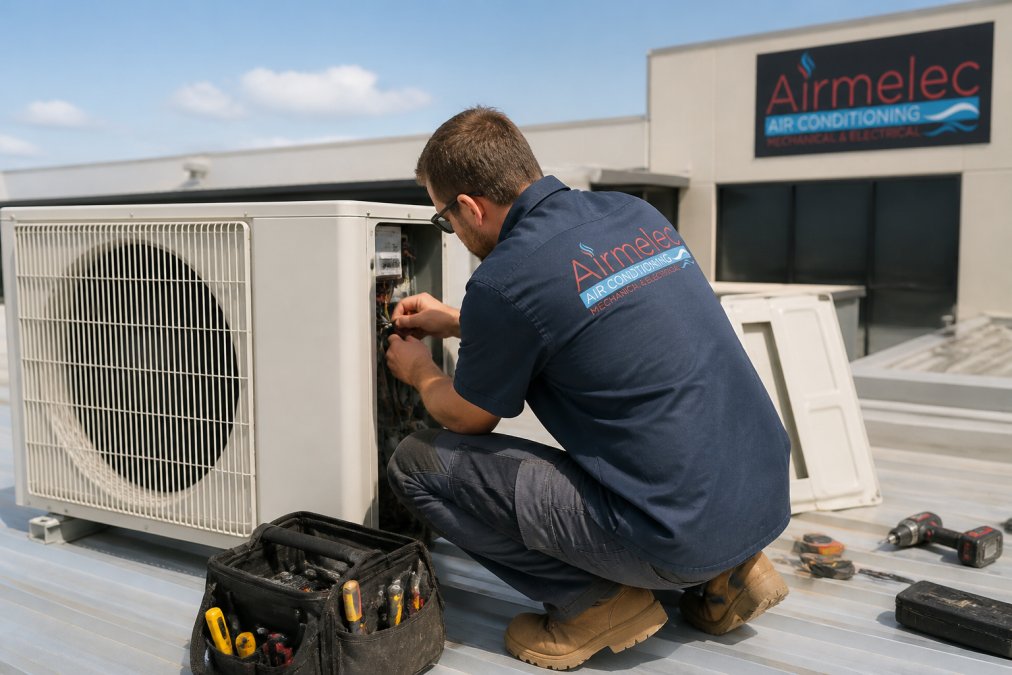
When your business outgrows its current setup, whether you’re expanding into a new office or upgrading from a residential-grade system, professional commercial HVAC installation becomes critical. The difference between DIY or amateur work and expert installation shows up immediately in energy bills, system reliability, and warranty coverage.
Air Conditioning & Electrical specialises in commercial HVAC installation for businesses across the region. Our fully licensed technicians handle everything from load calculations and system design through to complete installation and commissioning. We ensure your system meets local building codes, operates at peak efficiency, and integrates seamlessly with your building’s electrical infrastructure.
Key considerations for commercial installation include proper sizing (oversized systems waste energy; undersized ones can’t maintain comfort), ductwork design, refrigerant charge accuracy, and electrical integration. A professional installer tests system performance post-installation and provides documentation for your records and insurance.
Commercial systems typically require a site survey before quotes. This identifies challenges like existing ductwork, roof access, electrical capacity, and space constraints. Budget 2-3 weeks from survey to installation for standard builds.
2. Scheduled Maintenance Plans and Preventative Care
Scheduled maintenance plans are structured service agreements that include regular inspections, cleaning, and minor repairs on a fixed timeline. These plans are where most small businesses see the real return on their HVAC investment.
Preventative maintenance catches problems before they become emergencies. A technician inspects refrigerant levels, cleans filters and coils, checks electrical connections, and tests system controls. Most plans include 2-4 visits per year depending on your system’s age and usage intensity.
The cost of preventative maintenance is far lower than emergency repairs. A clogged filter or low refrigerant charge that goes unnoticed for weeks can damage the compressor, a replacement that costs significantly more than a maintenance call. Scheduled plans also extend system life by 5-10 years when done consistently.
Air Conditioning & Electrical offers flexible maintenance plans tailored to small business needs. We work around your operating hours, provide advance notice of visits, and prioritise emergency response for plan members. Our technicians document every service, so you have a complete maintenance history for warranty claims and future system decisions.
Maintenance plans pay for themselves through energy savings and avoided breakdowns within the first 18-24 months for most small businesses.
What makes a maintenance plan valuable isn’t just the service, it’s the priority access. When your air conditioning fails on a hot day mid-summer, plan members get same-day or next-day response. Non-members wait weeks.
3. Emergency Repair Services When You Need Them Most
Emergency repair services respond to unexpected HVAC failures. A system breakdown in summer or winter can shut down operations, damage inventory, or make your space unusable. Fast, reliable repairs are essential.
Most HVAC breakdowns fall into predictable categories: refrigerant leaks, compressor failure, electrical faults, thermostat malfunction, or ductwork blockages. A qualified technician diagnoses the issue on-site, explains repair options, and provides a clear quote before proceeding.
Air Conditioning & Electrical provides emergency repair services with rapid response times. Our licensed technicians carry common replacement parts and can often complete repairs the same day.
The key to minimising downtime is having a trusted service provider before you need one. Calling a random contractor during an emergency means longer wait times, higher costs, and no guarantee of quality. Existing customers get priority scheduling.
Ignoring warning signs, unusual noises, weak airflow, temperature inconsistency, can turn a small repair into a system replacement. A technician visit at the first sign of trouble prevents failures costing thousands.
4. Energy-Efficient HVAC Upgrades for Businesses
Energy-efficient HVAC upgrades replace older systems or install new technology that reduces power consumption while maintaining or improving comfort. Modern systems use variable-speed compressors, smart thermostats, and advanced refrigerants that deliver the same performance on less energy.
For small businesses, energy efficiency directly impacts operating costs. A business running air conditioning 8-10 hours daily can reduce monthly utility bills by 20-30% with an efficient system upgrade. Over 10 years, those savings compound significantly.
Upgrading also qualifies many businesses for government incentive programmes. In some regions, energy-efficient HVAC installations attract rebates or preferential financing. Air Conditioning & Electrical is an approved installer under the NSW Government’s Home Energy Saver loan programme, offering 0% interest finance options via Brighte for eligible upgrades.
Common upgrade paths include:
- Replacing single-speed systems with variable-capacity units
- Installing smart thermostats that learn your schedule and adjust automatically
- Upgrading to high-efficiency refrigerants with lower environmental impact
- Adding zone control so you only cool occupied areas
The upfront cost of an upgrade is offset by lower energy bills and reduced maintenance needs.
5. Commercial Air Conditioning Maintenance Checklist
A commercial air conditioning maintenance checklist is a systematic list of inspection and service tasks performed during routine maintenance visits. Following a checklist ensures nothing is overlooked and helps predict failures before they occur.
| Task | Frequency | Why It Matters |
|---|---|---|
| Replace or clean air filters | Monthly to quarterly | Clogged filters reduce airflow and system efficiency |
| Inspect refrigerant levels | Quarterly | Low refrigerant indicates a leak; overcharge damages the compressor |
| Clean evaporator and condenser coils | Annually | Dirty coils reduce heat transfer and efficiency |
| Check electrical connections | Annually | Loose connections overheat and cause component failure |
| Test thermostat accuracy | Annually | Faulty thermostats waste energy or leave spaces uncomfortable |
| Inspect ductwork for leaks | Annually | Leaky ducts waste 15-30% of conditioned air |
| Lubricate moving parts | Annually | Dry bearings and motors overheat and wear prematurely |
| Run system performance test | Quarterly | Documents baseline performance and flags degradation |
A thorough maintenance checklist typically costs less than a single emergency repair. Technicians should provide a written report after each visit showing what was inspected, what was serviced, and what, if anything, needs attention.
Air Conditioning & Electrical follows a detailed maintenance protocol on every service call. We document findings in a digital report you can access online, so you have a complete maintenance history. This transparency helps with budget planning and warranty compliance.
Small offices with 1-3 air conditioning units benefit most from annual maintenance visits. Larger facilities or high-use environments (retail, hospitality) should schedule quarterly service.
::: Coordinating these HVAC inspections with the installation of office data cabling ensures that your infrastructure remains organized and accessible for future technical upgrades.
6. HVAC and Electrical Integration Tips for Seamless Operation
HVAC and electrical integration refers to the coordination between your air conditioning system and the building’s electrical infrastructure. Poor integration causes voltage drops, circuit overloads, and system instability.
A commercial HVAC system draws significant power. An undersized electrical service, worn wiring, or incorrect circuit configuration can cause the system to underperform or fail entirely. Integration starts at the design stage, before installation begins.
Key integration points include:
- Electrical service capacity: Your main panel must have sufficient amperage to support the HVAC system plus other equipment. A 3-phase system requires different wiring than single-phase.
- Dedicated circuits: HVAC equipment should have dedicated circuits, not shared with general office loads.
- Grounding and bonding: Proper grounding protects equipment from voltage surges and prevents electrical faults.
- Control wiring: Thermostat wiring and control signals must be shielded and properly routed to avoid interference.
- Backup power: Critical systems may need uninterruptible power supply (UPS) or generator support.
Air Conditioning & Electrical combines HVAC and electrical expertise on every project. Our technicians coordinate system design, electrical upgrades, and installation to ensure seamless integration. This eliminates the common problem of hiring separate contractors who don’t communicate, and leaves you with conflicting work or gaps in responsibility.
A poorly integrated system costs more to operate, fails more often, and may void warranties.
7. Mechanical Services and System Upgrades for Reliability
Comprehensive HVAC services for small businesses cover the full spectrum of HVAC system work: installation, repair, maintenance, and upgrades. Reliability is the common thread, your system must perform when you need it.
- Adding zone control: Divide your space into independently controlled zones so different areas reach different temperatures.
- Upgrading to variable refrigerant flow (VRF): Advanced systems that adjust cooling capacity in real time, matching demand precisely and cutting energy use.
- Installing humidification or dehumidification: Critical for certain business types (data centres, retail, food storage).
- Retrofitting existing systems: Modernising older equipment with new controls and efficiency upgrades without full replacement.
Frequently Asked Questions
What is the standard maintenance schedule for commercial HVAC systems?
Commercial HVAC systems should be serviced at least twice yearly, typically before summer and winter seasons. Regular maintenance includes filter replacement, coil cleaning, refrigerant checks, and system performance testing. More frequent inspections may be needed for systems running continuously or in demanding environments. Preventative maintenance helps identify issues early, reduces energy consumption, and extends system lifespan significantly.
How does regular HVAC servicing improve energy efficiency for small businesses?
Regular servicing keeps HVAC systems operating at peak efficiency by ensuring clean filters, properly calibrated thermostats, and optimised refrigerant levels. When components work efficiently, your system uses less energy to maintain desired temperatures, directly reducing electricity bills. A well-maintained system also prevents energy waste from leaks, blockages, or worn parts. Most small businesses see measurable savings within the first year of consistent maintenance.
What qualifications should I look for in a commercial HVAC technician?
Ensure your technician holds current refrigeration and air conditioning licences issued by the relevant state authority. They should have formal trade qualifications, experience with commercial systems, and familiarity with your specific equipment type. Ask about insurance coverage and membership in professional bodies. Licensed technicians understand safety standards, building codes, and warranty requirements, protecting your business from faulty work and liability issues.
How do I know when my business needs an HVAC system upgrade?
Consider upgrading if your system is over 15 years old, requires frequent repairs, struggles to maintain consistent temperatures, or has rising energy costs despite regular maintenance. Modern systems offer better efficiency, quieter operation, and improved air quality. If your business has expanded or your cooling needs have changed, your current system may be undersized. A professional assessment can determine whether repair or replacement makes financial sense for your situation.