
Table of Contents
- Great Air vs Hawkesbury Contracting: At a Glance
- Great Air: Specialised Air Conditioning Maintenance
- Hawkesbury Contracting: Multi-Trade Project Capability
- How to Choose an HVAC Contractor for Your Property
- Your HVAC Maintenance Checklist: What to Expect From Either Provider
- Air Conditioning Installation Costs: What Drives the Price
- Regulatory Compliance and Licensing: What to Verify
- Conclusion: Which Provider Fits Your Project?
- Frequently Asked Questions
Last Updated: September 28, 2026
Great Air vs Hawkesbury Contracting: At a Glance
Choosing between different contractors often comes down to scope: some specialise in air conditioning maintenance, while others handle multi-trade building projects. For homeowners in the Hawkesbury and Hills region, the decision usually hinges on whether you need a focused HVAC specialist or a broader contracting team. This comparison from Air Conditioning & Electrical breaks down how different providers operate, what to verify before you hire, and where a dedicated air conditioning and electrical team fits into the picture. If your priority is a properly licensed technician who handles cooling, refrigeration and electrical work under one roof, that distinction matters more than brand recognition.
| Factor | Great Air | Hawkesbury Contracting |
|---|---|---|
| Primary focus | Air conditioning maintenance and servicing | Multi-trade building and project work |
| Best for | Routine servicing, chemical cleaning | Larger renovation and construction projects |
| Electrical capability | Limited to HVAC systems | Broader trade coordination |
| Maintenance plans | Contract-based options available | Project-dependent |
| Licensing to verify | Refrigeration and electrical licence | Building and trade licences |
Great Air: Specialised Air Conditioning Maintenance
Some providers position themselves around air conditioning servicing, chemical cleaning and diagnostic troubleshooting. That narrow focus suits homeowners who simply want their existing system running efficiently. A structured maintenance contract keeps filters clean and refrigerant levels correct, which supports energy efficiency over time. The trade-off is scope: if the same visit needs electrical fault finding or a switchboard upgrade, a specialist air conditioning provider may not cover it. What most guides miss is that maintenance quality depends less on the brand name and more on whether the technician holds a current refrigerant handling licence.
Hawkesbury Contracting: Multi-Trade Project Capability
Other contractors lean toward multi-trade project capability rather than pure HVAC servicing. For a renovation, granny flat build or extension, coordinating several trades through one contractor can reduce scheduling headaches. The catch is specialisation. When a project involves detailed system diagnostics or energy-efficient HVAC design, you want a qualified technician who works with cooling systems daily. A general contractor often subcontracts that work out, which adds a layer between you and the person doing the job. Ask directly who will perform the HVAC installation and what licence they hold.
How to Choose an HVAC Contractor for Your Property
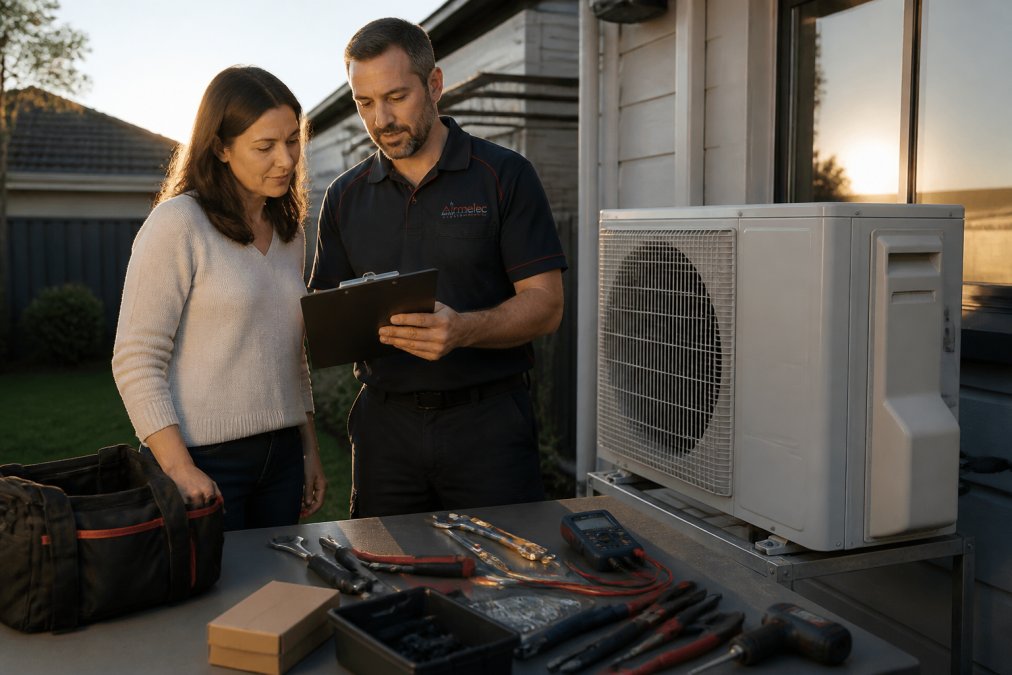
The right HVAC contractor is one who can show a current licence, explain the diagnosis in plain terms, and give you a written quote before work starts. What separates a good hire from a risky one is not the sales pitch, it is the paperwork you can verify before anyone touches your system.
Start with contractor verification. Ask for the licence number and check it against the relevant state register rather than accepting a photo of a card. Confirm the business holds public liability insurance and, where relevant, workers compensation cover for anyone attending your property. Ask for the name of the technician who will actually attend and what they are licensed to do, a supervisor’s licence does not automatically mean the person on site is qualified for refrigerant or electrical work.
A common pattern is that homeowners compare headline figures and skip the scope. A free quote should itemise labour, parts, and any compliance work such as electrical certification or refrigerant handling. If two quotes differ sharply, the gap is usually in what has been excluded, not in the quality of the work.
Local trade services with a physical presence in your area are easier to hold accountable than a call centre that dispatches unknown subcontractors. That matters most when something goes wrong after the job is finished and you need the same team to return.
- Confirm the contractor’s licence number and check it against the state register
- Ask which qualified technician will attend and what they are licensed to do
- Request a written, itemised quote covering labour, parts and compliance
- Check warranty coverage and what it excludes
- Confirm response times for emergency repair before you sign
Ask for the licence number before you book, not on the day. A legitimate contractor will provide it without hesitation, and you can verify it in minutes. If they deflect, that is your answer.
A contractor who volunteers their licence, insurance details and the name of the attending technician is usually the one who will also stand behind the work. Treat reluctance to provide any of these as a warning sign, not a minor inconvenience.
Your HVAC Maintenance Checklist: What to Expect From Either Provider
A thorough preventative maintenance visit covers more than a quick filter change. Expect system diagnostics, coil and drain inspection, refrigerant pressure checks and a written summary of what was found. Preventative servicing twice a year keeps operational reliability high and catches small faults before they become expensive repairs. Whether you choose a specialist or a multi-trade firm, the checklist should be the same, and you should receive documentation afterwards. For businesses, a service level agreement formalises response times and scheduled servicing, which matters when downtime affects trading.
Air Conditioning Installation Costs: What Drives the Price
Air conditioning installation costs depend on system size, property layout, whether new electrical circuits are needed, and the efficiency rating of the unit you select. A straightforward replacement costs less than a new install requiring ductwork or switchboard work. Because pricing varies so much by property, a reputable provider will assess on site before quoting rather than guessing over the phone. Flexible payment options, including approved finance arrangements for energy-efficient upgrades, can spread the cost of a larger system. Always compare quotes on what is included, not just the headline figure.
A quote that is dramatically lower than the others usually excludes something: compliance work, removal of the old unit, or electrical upgrades. Confirm the scope in writing before you commit, or you may pay for the difference later.
Regulatory Compliance and Licensing: What to Verify
Compliance is where cheap quotes quietly cut corners. Air conditioning and refrigeration work is regulated, and technicians handling refrigerants must hold the appropriate licence. Electrical work must be carried out by a licensed electrician and, in many cases, certified on completion. Before hiring any contractor, verify three things: the relevant trade licence, public liability insurance, and whether the work will be certified.
Most guides stop there. A more useful approach is to check the business itself, not just the trade qualification. Every business trading in Australia should have an Australian Business Number (ABN), which you can look up on the Australian Business Register to confirm the entity is active and that the name on the quote matches the name on the register. A mismatch is a common red flag, it can mean the person quoting is not the entity that will carry the liability.
Insurance is the second layer. Ask for a certificate of currency for public liability cover and check the expiry date, not just the presence of a document.
A simple pre-hire checklist:
- ABN confirmed on the Australian Business Register and matching the quoting entity
- Public liability certificate of currency sighted, with a current expiry date
- Workers compensation cover confirmed where staff are employed
- Trade licence number verified against the relevant state register
- Written confirmation of who will certify the completed work
Verifying an ABN confirms the business exists, it does not confirm the business is licensed for the specific trade work you need. Always check the trade licence separately.
Conclusion: Which Provider Fits Your Project?
Different contractors serve different needs, and neither is automatically the right call. If you need routine servicing and chemical cleaning, a focused specialist works well. For a broader build, a multi-trade contractor simplifies coordination. Where the two overlap, and where most homeowners get stuck, is a project needing both HVAC and electrical work done properly. That is where a licensed team covering air conditioning, refrigeration and electrical services under one roof removes the handover risk.
Frequently Asked Questions
What should I look for when comparing HVAC contractors?
Check licensing, insurance, and whether the contractor holds a current refrigerant handling licence. Look at the scope of services: some providers handle air conditioning only, while others cover electrical, refrigeration, and security work. Ask about warranty coverage on parts and labour, response times for emergency repair, and whether they offer a written service level agreement. A free quote and on-site assessment before work begins are standard expectations.
How do I verify the credentials of an air conditioning technician?
Ask for their licence number and check it against the relevant state register. In New South Wales, electrical work requires a licensed electrician, and refrigerant handling requires a separate licence. You can also ask whether the business is an approved installer under government energy programs, which adds a layer of contractor verification. A qualified technician should provide certification details on request without hesitation.
What services do local HVAC contractors typically provide?
Most offer installation, preventative maintenance, fault finding, and emergency repair for split systems, ducted units, and commercial refrigeration. Some, like full-service electrical and HVAC providers, also handle system upgrades, electrical panel work, and security installations. If you need turnkey solutions for a new build or granny flat, confirm the contractor can manage both trades under one project estimation rather than subcontracting.
How do I get an accurate quote for air conditioning installation?
Book an on-site assessment so the contractor can measure the space, check existing infrastructure, and recommend the right system capacity. An accurate quote should itemise the unit, labour, materials, and any electrical upgrades required. Be wary of phone-only estimates. Ask whether the quote includes warranty coverage and whether payment plans or government loan programs apply. Always compare at least two written quotes before committing.
Are maintenance plans worth the cost for air conditioning systems?
A structured maintenance plan typically covers preventative servicing, filter cleaning, and system diagnostics once or twice a year. The cost-benefit depends on your system age and usage. Regular servicing maintains energy efficiency, extends equipment life, and reduces the chance of breakdown during peak summer. For commercial refrigeration or multi-unit installations, a service level agreement with defined response times is often essential for operational reliability.