
Table of Contents
- Start With Your Thermostat Setpoint
- Energy Efficient Air Conditioning Settings That Cut Running Costs
- Your Air Conditioner Maintenance Checklist for Peak Efficiency
- Seal Air Leakage and Improve Insulation
- How to Size an Air Conditioner for a Room
- Smart Controls, Ceiling Fans, and Zoning
- Repair or Replace? A Cost-Benefit Framework
- Frequently Asked Questions
Last Updated: September 30, 2026
Start With Your Thermostat Setpoint
The fastest way to lower air conditioning bills is to raise your thermostat setpoint, and the same habit trims air conditioning bills month after month. Every degree you lift the setpoint cuts running costs, because the compressor cycles less often to hold the room at temperature.
Most homes sit at 20°C or lower. That is colder than it needs to be.
Try 24°C in summer instead. Then adjust by one degree at a time until you find a point your household finds comfortable. This guide from Air Conditioning & Electrical covers the settings, habits and hardware that cut power consumption without turning your home into a sauna.
The logic is simple. Cooling load is the heat your system must remove. A higher setpoint means a smaller gap between indoor and ambient temperature, so the compressor works less.
- Set 24°C in summer, 20°C in winter
- Raise it one degree while you are out
- Do not swing the setpoint up and down through the day
- Give the system an hour to settle after each change
What most guides miss is the recovery penalty. Turning the system off completely and blasting it on return uses more power than holding a steady, moderate setpoint. The system has to work harder to pull down a hot, humid room than it does to maintain a cool one.
Set a timer so the system starts 30 minutes before you get home, not when you walk in. You avoid the recovery spike and still walk into a cool house.
Energy Efficient Air Conditioning Settings That Cut Running Costs
Two settings do most of the heavy lifting: temperature and fan speed. Get both right and your electricity bill drops without any loss of comfort.
Thermostat setpoint is the target temperature. Fan speed controls how fast air moves across the room. Higher fan speed spreads cool air further, so the room feels cooler at a higher setpoint.
That combination is the trick. A higher setpoint with a faster fan often feels the same as a lower setpoint with a slow fan, but costs less to run.
Use these settings as a starting point:
- Summer cooling: 24-26°C, fan on medium or high
- Winter heating: 18-20°C, fan on low
- Dry mode: use it in humid weather instead of cooling
- Auto mode: fine for mild days, wasteful in extreme heat
Dehumidification matters more than people think. A humid room feels warmer than a dry one at the same temperature. Dry mode removes moisture without overcooling, so you can run it at a higher setpoint and still feel comfortable.
Seasonal adjustment helps too. In shoulder seasons, you may not need the compressor at all. Fan-only mode moves air and costs a fraction of full cooling.
Your Air Conditioner Maintenance Checklist for Peak Efficiency
A dirty system is an expensive system. Filter replacement and coil cleaning are the two maintenance jobs that protect efficiency most, and both are easy to get wrong by simply forgetting them.
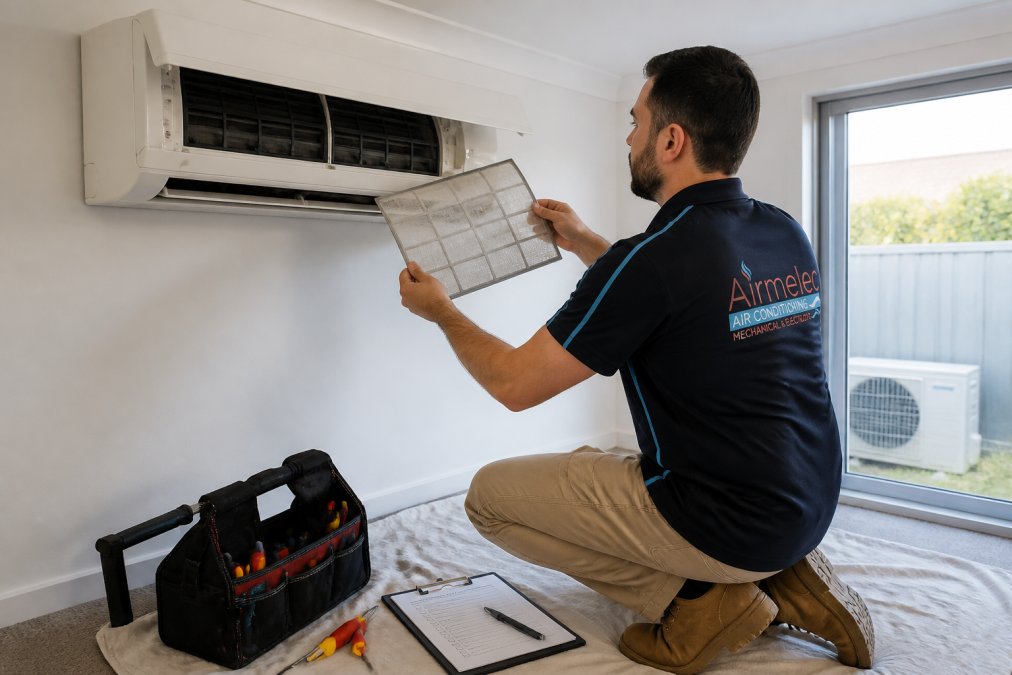
Run through this air conditioner maintenance checklist each season:
- Clean or replace filters every 2-4 weeks in heavy use
- Clear dust and debris from outdoor unit fins
- Check the condensate drain for blockages
- Inspect refrigerant lines for frost or damage
- Clean the indoor unit’s air intake grille
- Book a professional service once a year
A blocked filter chokes airflow. The system runs longer to hit the setpoint, and the compressor wears faster. Filters are cheap. Compressors are not.
Outdoor units matter just as much. If the unit is buried in leaves or boxed in by plants, it cannot reject heat. Keep at least 30cm of clear space around it.
Skipping the annual service voids many warranties and lets small refrigerant leaks turn into full compressor failures. A routine service costs far less than a replacement.
Seal Air Leakage and Improve Insulation
Air leakage and poor insulation let heat back into your home as fast as the system removes it. Fix the envelope and your cooling load drops before you touch the thermostat.
Check these spots first:
- Door and window seals
- Ceiling penetrations and downlights
- Exhaust fans and rangehoods
- Wall vents and gaps around pipes
Insulation works with sealing, not instead of it. Ceiling insulation is the highest-value upgrade in most homes, because heat rises and enters through the roof. Add batts or top up existing insulation to reduce solar heat gain through the ceiling.
Glazing matters too. Single-pane windows lose cool air fast. Heavy curtains and external blinds cut solar heat gain on west-facing glass, which is where afternoon heat hits hardest.
The goal is a tighter, better-insulated box. The less heat gets in, the less the system has to remove.
How to Size an Air Conditioner for a Room
To size an air conditioner for a room, match the unit’s cooling capacity to the room’s cooling load. An oversized unit cools fast but short-cycles, which wastes power and wears the compressor. An undersized unit runs constantly and never quite gets there.
A rough starting guide for room size:
| Room Size | Approx. Cooling Capacity | Typical Use |
|---|---|---|
| Up to 20m² | 2.5-3.5kW | Bedroom, study |
| 20-40m² | 3.5-5kW | Living room |
| 40-60m² | 5-7kW | Open-plan living |
| 60m²+ | 7kW+ or multi-head | Whole-floor |
These are starting points, not rules. Real cooling load depends on ceiling height, insulation, glazing, sun exposure and how many people use the room. A west-facing room with big windows needs more capacity than a shaded one of the same size.
Get the sizing wrong and you pay for it every month.
Correct sizing beats a bigger unit every time. An oversized system short-cycles, which means higher power consumption and a shorter service life.
Smart Controls, Ceiling Fans, and Zoning
Most guides stop at “get a programmable thermostat”. That is the entry point, not the finish line. The real savings come from letting sensors and schedules make setpoint decisions for you, so the system is never cooling an empty room or fighting a heat load it cannot see.
-
Occupancy sensing detects when rooms are empty and relaxes the setpoint automatically, so you are not relying on remembering to adjust it.
-
Geofencing uses your phone’s location to switch between “home” and “away” setpoints, which suits households with irregular hours better than a fixed schedule.
-
Humidity sensing lets the system prioritise moisture removal on muggy days, so a higher dry-bulb setpoint still feels comfortable.
-
Weather and tariff awareness lets some controllers pre-cool before a forecast hot spell or shift run time away from peak electricity periods.
-
Use fans in occupied rooms only
-
Turn fans off when you leave, they cool people, not air
-
Pair fans with zoning for the biggest gain
-
Set schedules around your actual routine, not an idealised one
If you are not ready for a full smart system, a cheap plug-in timer on the outdoor unit plus a ceiling fan in the main living area captures a large share of the benefit for a fraction of the cost.
Repair or Replace? A Cost-Benefit Framework
Decide based on age, repair history and running cost, not on the repair quote alone. A cheap fix on an inefficient system can cost more over the next two years than a replacement would. The trick is to make the call with a repeatable framework rather than a gut feel.
- Minor faults, a failed capacitor, a clogged drain, a faulty thermostat or a worn fan motor, are usually worth repairing if the rest of the system is sound.
- Major faults, compressor failure, a leaking evaporator coil, or a refrigerant circuit that keeps losing charge, are expensive to fix and often indicate the system is near the end of its life.
- Repeated faults, three or more repairs in two years, point to a system that will keep draining your budget.
A simple decision path:
| Situation | Likely call |
|---|---|
| Young unit, first minor fault | Repair |
| Mid-life unit, repair under a third of replacement cost | Repair |
| Mid-life unit, repair over a third of replacement cost | Get quotes both ways |
| Old unit, major fault (compressor or coil) | Replace |
| Any age, three or more repairs in two years | Replace |
| Old unit, bills rising despite steady use | Replace |
Run the five steps before you accept a repair quote. The cheapest fix today is not always the cheapest option over the next three years.
Frequently Asked Questions
What should I keep my air conditioner on to keep my bill low?
Set your air conditioner to 24-26°C in summer rather than 18-20°C. Every degree you raise the setpoint reduces power consumption by roughly 5-10%, because the compressor runs for shorter cycles. Pair this with ceiling fans on low speed so the room feels 2-3°C cooler than the thermostat reading. Use the timer or sleep mode overnight so the system doesn’t run at full output while you’re asleep.
How often should I service my air conditioner to maintain efficiency?
Book a professional service once a year, ideally before summer. Between services, clean or rinse the indoor filters every two to four weeks during heavy use, because dust blocks airflow and forces the compressor to work harder. Check the outdoor unit for leaves and debris monthly. A neglected filter alone can add 5-15% to running costs over a season.
Are inverter air conditioners cheaper to run?
Yes, in most homes. An inverter compressor varies its speed instead of switching fully on and off, so it holds the setpoint with less peak demand and fewer start-up surges. That means lower kilowatt-hours across the day, especially in rooms used for hours at a time. The savings are largest when the system is correctly sized for the room and the thermostat is left at a steady setting.
How does insulation impact my air conditioning energy consumption?
Insulation slows heat transfer through ceilings, walls and floors, so your cooling load drops and the system cycles less. Ceiling insulation is the highest-value upgrade in most homes, followed by draught sealing around doors, windows and exhaust fans. Together, these reduce air leakage and keep conditioned air inside, which lowers both your electricity bill and the size of system you need.