
Table of Contents
- Why Electrical Hazards Are Easy to Miss
- Common Electrical Warning Signs You Should Never Ignore
- Signs of Faulty Electrical Wiring Hiding in Plain Sight
- Overloaded Circuits, Power Boards and Damaged Cords
- Your Electrical Safety Inspection Checklist
- When to Call an Emergency Electrician
- DIY vs Professional Scope: What You Should Never Touch
- Conclusion: Turning Awareness into Action
- Frequently Asked Questions
Last Updated: September 10, 2026
Why Electrical Hazards Are Easy to Miss
Electrical hazards rarely announce themselves. According to Safe Work Australia’s guidance on electrical safety, most electrical incidents involve equipment that appeared to be working normally right up until it failed. This guide explains how to spot electrical hazards before they cause shock, fire or worse.
The problem is that electricity gives almost no warning. A cable can look fine on the outside while the copper inside has corroded. A switchboard can hum along for years before a loose connection finally arcs. By the time you smell burning or see a scorch mark, the fault has usually been developing for months.
Below, we break down the warning signs worth acting on, the checks you can safely do yourself, and the point where you should stop and call a licensed electrician.
Common Electrical Warning Signs You Should Never Ignore
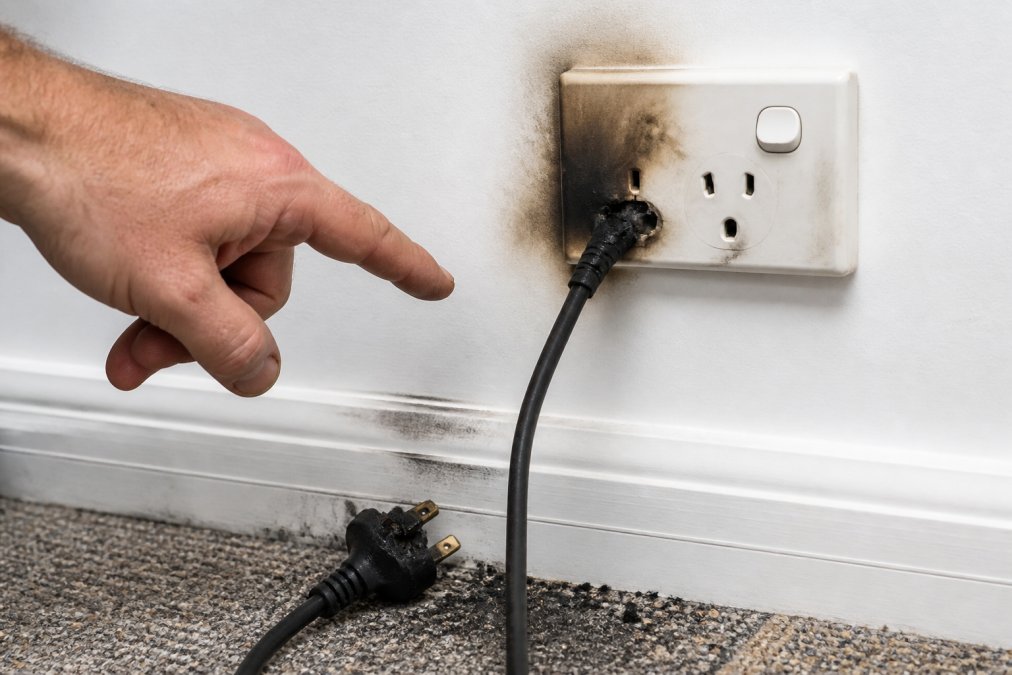
The clearest electrical warning signs are heat, smell and sound: scorch marks, burning odours, hot outlets, buzzing and breakers that trip repeatedly. Any one of these means the circuit is under stress or a connection is failing.
Scorch Marks, Burning Smells and Hot Outlets
Discolouration around a socket, a fishy or burning smell near a switchboard, or an outlet that feels warm to touch all point to overheating. A common mistake is assuming a warm plug is normal. It isn’t. Heat means resistance, and resistance means the connection is degrading.
Flickering Lights, Buzzing Sounds and Tripping Breakers
Lights that flicker when appliances switch on, a faint buzz from a switchboard, or a circuit breaker that trips more than once are all signs of an underlying fault. A safety switch, also called a residual current device or RCD, should be tested regularly, and a breaker that keeps tripping is doing its job, not malfunctioning.
Never reset a tripped breaker repeatedly to “see if it holds.” Each reset sends current through a fault that may be arcing inside a wall. If it trips twice, stop and book an electrician.
Signs of Faulty Electrical Wiring Hiding in Plain Sight
Signs of faulty electrical wiring often show up as small inconveniences: a dimmer switch that feels warm, a light that flickers in one room only, or a plug that needs wiggling to work. These aren’t quirks. They’re symptoms.
Older homes are the usual suspects. Insulation deteriorates with age, rodent damage goes unnoticed behind plasterboard, and DIY additions from decades past may never have met current standards. A visual inspection of visible cabling, switchboards and outlets is worth doing every few months, and any cable that is cracked, brittle or discoloured should be treated as live until proven otherwise.
Overloaded Circuits, Power Boards and Damaged Cords
Overloaded circuits are the most preventable hazard in most homes. Power boards daisy-chained into other power boards, heaters and kettles sharing one outlet, and extension leads running under rugs all push a single circuit past what it was designed to carry.
Damaged cords deserve the same suspicion. Frayed insulation, a plug with a cracked casing, or a cord that’s warm after use should be replaced, not taped. Portable electrical equipment used in workshops, garages or on job sites should be tested and tagged on a regular schedule as part of routine electrical maintenance.
| Warning Sign | What It Usually Means | What To Do |
|---|---|---|
| Warm outlet or plug | Loose or corroded connection | Stop using the outlet, book an electrician |
| Burning smell | Overheating component or insulation | Switch off the circuit at the switchboard |
| Repeated breaker trips | Short circuit or overloaded circuit | Don’t keep resetting, call a professional |
| Frayed or damaged cord | Insulation failure | Replace the item or have the lead rewired |
| Buzzing switchboard | Arcing or loose termination | Treat as urgent, isolate power if safe |
Touch test with the back of your hand, never your palm. If an outlet or switch plate feels noticeably warm, that’s your signal to stop using it before you even reach for a tool.
Your Electrical Safety Inspection Checklist
An electrical safety inspection checklist is only useful if you know what you’re looking for. A tick-box list without context leads people to tick items they haven’t actually assessed. Below is a monthly routine with the specific observation that tells you whether each item passes or needs attention.
What To Check and What a Problem Looks Like
- Test every safety switch using its test button. Press the button marked ‘T’ or ‘Test’. The switch should trip immediately and cut power to the protected circuit. If it doesn’t trip, or trips but won’t reset, the device has failed and the circuit is unprotected.
- Look for scorch marks, discolouration or heat around outlets and switches. Compare the wall plate colour to surrounding plates. A brown or yellow halo, or a plate that feels warm to the back of your hand, indicates resistance heating at the terminals.
- Check power boards for overloaded sockets and daisy-chaining. One power board per outlet is the limit. A power board plugged into another power board is a daisy chain and should be broken up immediately.
- Inspect visible cords for fraying, cracking or taped repairs. Run your hand along the cord (with the appliance unplugged). Any exposed conductor, brittle outer sheath, or tape repair means the lead needs replacing, not repairing.
- Listen for buzzing at the switchboard or outlets. A faint hum from a switchboard is normal. A buzz, crackle or sizzle is arcing and warrants an urgent call.
- Confirm outdoor outlets have weatherproof covers. The cover should seal fully when the outlet is not in use. A missing or cracked cover lets moisture reach live terminals.
- Note any lights that flicker consistently. Flicker in one room only points to a local connection; flicker across the whole house points to the main supply or switchboard.
- Check that smoke alarms are working. Press the test button until the alarm sounds. Replace batteries annually and the unit every ten years, per the manufacturer’s date stamp. (information on smoke alarm maintenance)
A Checklist for Renters
Renters can’t rewire a property, but they can document and report. Under residential tenancy laws in most states and territories, a landlord has an obligation to maintain the property in a reasonable state of repair, and electrical faults that pose a safety risk generally fall within that obligation. If you rent:
- Report faults in writing (email or the agent’s maintenance portal) so there’s a dated record.
- Photograph scorch marks, damaged cords and any outlet that feels warm before reporting.
- If a safety switch won’t reset or a breaker trips repeatedly, treat it as urgent and request an electrician the same day.
- If the landlord or agent doesn’t act on a serious hazard, contact your state or territory tenancy authority or work health and safety regulator for guidance.
Seasonal Checks Worth Adding
Most checklists are written for a generic day. Loads change with the seasons, so add these:
- Before summer: check that air conditioner circuits aren’t sharing a power board with other high-draw appliances, and that outdoor outlets are sealed before the wet season.
- Before winter: inspect heater cords for damage, confirm heaters aren’t placed against curtains or bedding, and avoid running electric blankets through damaged leads.
- Before the holiday period: inspect decorative light strings for cracked insulation and broken globes, use an outdoor-rated transformer for exterior displays, and don’t daisy-chain more than the manufacturer’s stated maximum.
For workplaces, this checklist forms part of a broader hazard identification and risk assessment process. Under work health and safety laws, a person conducting a business or undertaking must manage electrical risks so far as is reasonably practicable, and portable equipment should be added to a testing and tagging schedule with results recorded.
Do the walk-through in daylight with the power on, but keep one hand free and never touch a switch or outlet with wet hands. If you find a fault, isolate the circuit at the switchboard before investigating further.
When to Call an Emergency Electrician
Call an emergency electrician immediately if you smell burning near a switchboard, see sparks, hear loud buzzing, or notice a hot outlet that won’t cool down. These are signs of an active fault that can lead to an electrical fire.
Don’t wait for a convenient appointment if any of the following apply:
- Smoke or visible sparks from any outlet or appliance
- A burning smell that doesn’t clear when you switch a circuit off
- Water contact with live wiring or a flooded power point
- Anyone in the household has received even a mild electric shock
For non-urgent issues, a standard booking is fine. Our licensed electricians handle both routine maintenance and urgent call-outs.
DIY vs Professional Scope: What You Should Never Touch
DIY electrical work in Australia is not a grey area. Electrical work on fixed wiring is licensed work, and doing it yourself, or hiring an unlicensed person, is an offence in every state and territory. The line is drawn by law, not by difficulty.
What You Can Legally Do Yourself
The tasks a homeowner can safely and legally perform are narrow:
- Changing a light globe or fluorescent tube
- Resetting a safety switch or circuit breaker at the switchboard
- Replacing a plug-in appliance’s removable fuse (where the plug is a rewireable type)
- Plugging and unplugging appliances, and using extension leads within their rating
- Replacing a battery in a smoke alarm
Anything beyond this, even ‘simple’ jobs like swapping a power point or light switch, involves fixed wiring and requires a licensed electrician.
What Requires a Licensed Electrician
In Australia, the following work is restricted to holders of an electrical licence issued by the relevant state or territory regulator:
- Installing, altering or repairing any fixed wiring
- Replacing power points, light switches, ceiling fans or light fittings that are hard-wired
- Installing new circuits, sub-boards or switchboard upgrades
- Wiring a granny flat, shed, extension or renovation
- Installing or replacing safety switches and circuit breakers
- Any work on solar, battery storage or electric vehicle charging equipment
Most jurisdictions require the electrician to issue a Certificate of Electrical Safety (the name varies by state, for example, a Certificate of Compliance in some jurisdictions) after prescribed work. Keep this document: it’s your proof the work was done lawfully and is often required when you sell or lease the property.
The Penalties for Getting It Wrong
Unlicensed electrical work carries real consequences:
- Fines: Penalties for unlicensed electrical work run into tens of thousands of dollars for individuals and higher for companies, and vary by state.
- Insurance: If a fire or injury is traced to unlicensed work, your insurer may refuse the claim, leaving you liable for damage and injury costs.
- Liability: If a tenant, guest or tradesperson is injured, you may face personal liability.
- Sale and lease problems: Uncertified work can stall a property sale or breach tenancy and building requirements.
How To Verify a Licence
Before hiring anyone, check their licence. Every state and territory maintains a public register:
- Ask for the electrician’s licence number and the name of the issuing regulator.
- Look up the number on the regulator’s online register to confirm it’s current and covers the work you need.
- Ask for the Certificate of Electrical Safety after the job and check it matches the work performed.
- Be wary of anyone who offers to do ‘cash, no certificate’, that’s a red flag for unlicensed or non-compliant work.
Where the Scope Blurs
Some jobs sit near the boundary and are worth clarifying:
- Replacing a plug-in appliance: fine. Rewiring the lead: licensed work.
- Changing a light globe: fine. Replacing the light fitting: licensed work.
- Resetting a tripped breaker: fine. Replacing the breaker: licensed work.
- Using an extension lead: fine. Installing a new outlet: licensed work.
If you’re renovating or building, engaging one licensed team for the electrical and HVAC scope keeps compliance in one place and avoids the common problem of two trades blaming each other for a defect.
The line is simple: if it involves fixed wiring, a switchboard, or opening a wall, it’s licensed work and must be certified. If it plugs in or screws in by hand, you can usually handle it yourself.
Conclusion: Turning Awareness into Action
Spotting electrical hazards is a skill, and like any skill it improves with repetition. Run the checklist monthly, act on warning signs the first time you notice them, and respect the boundary between what you can safely do yourself and what needs a licensed professional.
If something on this list has you concerned, Airmelec‘s fully licensed electricians can inspect your switchboard, test your safety switches, and diagnose faults before they become emergencies. As an approved installer under the NSW Government’s Home Energy Saver loan program, with 0% interest finance options available through Brighte, we make it easier to upgrade ageing electrical systems and improve home safety without a large upfront cost. Get a quote today and let our team put your mind at ease.
Frequently Asked Questions
How do I identify electrical hazards in my home?
Start with a visual inspection of your switchboard, outlets, cords and appliances. Look for scorch marks, hot outlets, flickering lights, buzzing sounds and tripping breakers. Check that safety switches (RCDs) are installed and test them monthly. If you notice any of these signs, or if your home is more than 25 years old, arrange a professional electrical safety inspection. Never ignore warning signs, as they can lead to electrical fire or shock.
What are the most common signs of faulty electrical wiring?
The clearest signs of faulty electrical wiring include frequent tripping of circuit breakers, a burning smell near outlets or the switchboard, flickering or dimming lights, and discoloured or warm power points. You might also notice buzzing sounds, mild shocks from appliances, or a fuse that blows repeatedly. These symptoms suggest deterioration or damage inside the wiring, which only a licensed electrician should investigate. Early detection prevents electrical fires and expensive rewiring.
When should you call an emergency electrician for a safety inspection?
Call an emergency electrician immediately if you see sparks, smell burning, have a hot switchboard, or if someone receives an electric shock. Also act urgently if a breaker will not reset, if water has entered electrical fittings, or if you hear loud buzzing from the fuse box. These situations carry a high risk of electrocution or fire. For non-urgent concerns like occasional flickering, book a standard inspection. Delaying emergency repairs can void insurance and endanger lives.
What are the legal requirements for electrical safety in residential properties?
In residential properties, all electrical work must be carried out by a licensed electrician and comply with AS/NZS 3000 wiring rules. Safety switches (RCDs) are mandatory on all final subcircuits in new homes and recommended for older homes. Landlords must ensure electrical installations are safe and maintained. Regular testing and tagging of portable equipment is required in workplaces. For specific obligations, check with your state electrical safety regulator or a licensed professional.