
Table of Contents
- What Is the Home Energy Saver Loan and How Does It Work?
- Who Qualifies? Eligibility Criteria for Homeowners
- Energy Efficient Home Upgrades NSW Households Can Finance
- How to Reduce Electricity Bills with Energy Upgrades
- Government Rebates for Home Energy Efficiency and How They Stack
- Repayment Terms, Limits and What Happens If You Move
- Home Energy Saver Loan vs Private Green Loans
- Frequently Asked Questions
Last Updated: September 14, 2026
What Is the Home Energy Saver Loan and How Does It Work?
The Home Energy Saver loan is a NSW Government-backed scheme that lets eligible homeowners borrow for approved energy-efficient upgrades and repay with zero interest. At Airmelec, we work with this program regularly, and the biggest benefit of the home energy saver loan is simple: it removes the upfront cost barrier that stops most households from upgrading.
The loan is delivered through Brighte, an approved finance provider, and the NSW Government covers the interest. You apply, get approved, and repay in instalments over an agreed term, repaying exactly what you borrow.
A standard personal loan for a solar or air conditioning upgrade carries interest on top of the principal, adding thousands over its life. The home energy saver loan avoids that entirely.
Zero-Interest Finance and the Brighte Partnership
Brighte acts as lender and manages the application, approval and repayment process, while the NSW Government subsidises the interest so the loan stays at 0%.
A few practical points worth knowing:
- The loan is interest-free, not fee-free in every scenario, so read the loan guidelines carefully
- Approval is generally fast, often same-day for straightforward applications
- Repayments are made fortnightly or monthly, depending on what you choose
- The finance is tied to the installation, so funds are typically released to your approved contractor
Who Qualifies? Eligibility Criteria for Homeowners
To qualify, you generally need to own the property, live in it, and meet the program’s household income or concession requirements. The scheme is designed for owner-occupiers, so investment properties usually don’t qualify.
The exact thresholds are set by the NSW Government and can change, so check the official NSW Government Home Energy Saver program page for current figures before you apply. What we can tell you is the broad shape of the criteria.
Concession Card Holders and Income Thresholds
Concession card holders often get the most generous terms and sometimes a lower eligibility bar. Mention your card early, as it can affect both eligibility and your repayment period.
For everyone else, eligibility usually hinges on:
- Property ownership and occupancy status
- Household income falling under a set threshold
- The property being your primary place of residence
- Using an approved contractor for the installation
Apply for the loan before you sign anything with a contractor. The approval needs to be tied to the installation, and getting the finance sorted first avoids a situation where you’ve committed to work you can’t yet fund.
Energy Efficient Home Upgrades NSW Households Can Finance
The scheme covers a defined list of upgrades, not every energy improvement. Core eligible categories are solar, battery storage and hot water systems, with some heating and cooling upgrades depending on current rules.
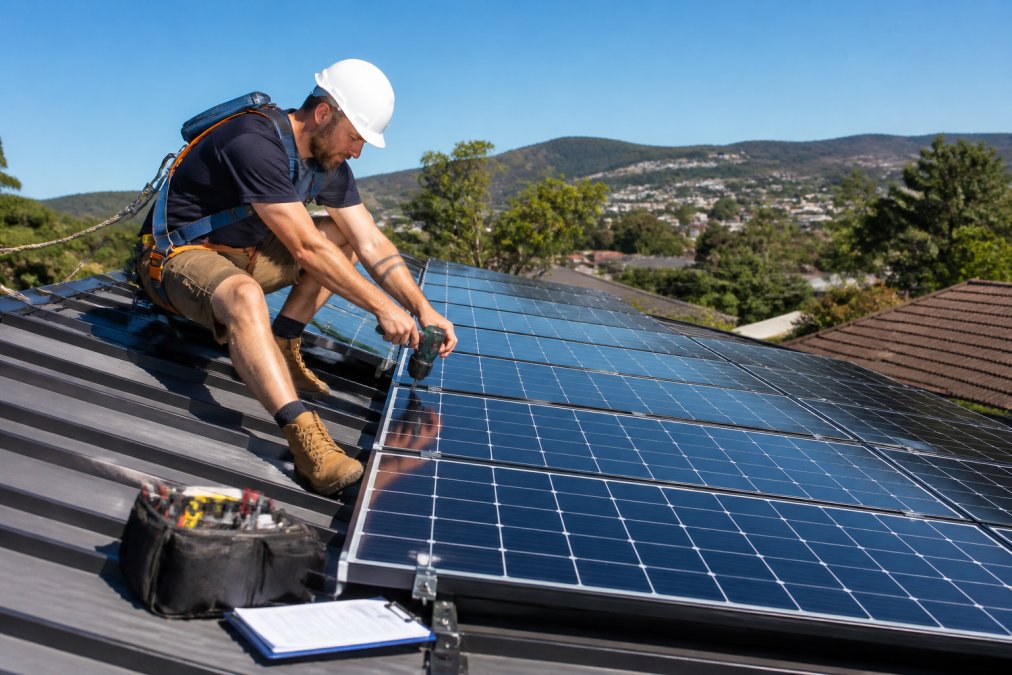
Solar, Battery Storage and Hot Water Systems
Rooftop solar is the headline upgrade and usually the clearest return, because a well-sized system offsets daytime electricity use directly, where most households spend the most.
Battery storage changes the economics: without one, excess solar is exported for a modest feed-in tariff, but with a battery you store that energy and use it in the evening when grid prices are highest.
Hot water systems round out the trio: electric resistance hot water is one of the biggest single energy draws in many homes, so switching to a heat pump or solar hot water cuts that load substantially.
| Upgrade | Main Benefit | Best For |
|---|---|---|
| Rooftop solar | Offsets daytime power use | Homes with high daytime consumption |
| Battery storage | Stores excess solar for evening use | Households on time-of-use tariffs |
| Hot water system | Cuts a major continuous load | Older homes with electric hot water |
| Heating and cooling | Improves thermal comfort efficiently | Homes with outdated systems |
How to Reduce Electricity Bills with Energy Upgrades
Reducing electricity bills with energy upgrades means cutting the biggest loads first, then shifting the rest to cheaper times. Most households attack the wrong thing first and wonder why the bill barely moves.
The biggest loads in a typical home are heating and cooling, hot water and refrigeration. If your air conditioning is old or undersized it runs longer and harder, which is why how to reduce electricity bills with energy upgrades usually starts with HVAC.
A few moves that reliably help:
- Replace an ageing air conditioner with a correctly sized, efficient unit
- Add solar to cover daytime running costs
- Switch electric hot water to a heat pump
- Add a battery to use your own solar at night
- Seal draughts and improve insulation so your system works less
Sizing an air conditioner by guesswork is one of the most expensive mistakes we see. An oversized unit short-cycles, dehumidifies poorly and wears out faster; an undersized one runs flat out and never reaches setpoint. Both cost you more over time.
Government Rebates for Home Energy Efficiency and How They Stack
Government rebates for home energy efficiency can be combined with the loan, which is where savings compound. The loan handles the finance; rebates reduce what you need to borrow. Get the order right and you finance a smaller principal; get it wrong and you miss a rebate or borrow more than needed.
The Main Schemes Worth Knowing
Rebate programs change with each budget cycle, but the categories that consistently apply include:
- Small-scale technology certificates (STCs), a federal mechanism that effectively discounts the upfront cost of eligible solar, battery and heat pump installations. Your installer usually applies the discount directly to your quote rather than you claiming it separately.
- State-based energy savings schemes, these vary by jurisdiction and typically reward specific upgrades such as replacing electric resistance hot water with a heat pump, or upgrading to more efficient appliances.
- Concession-linked assistance, some households on concession cards can access additional support layered on top of the standard rebates.
- Feed-in tariff arrangements, not a rebate as such, but a recurring credit that changes the payback maths on solar and battery combinations.
Because the exact dollar values and eligibility rules shift, treat any figure you see quoted online as indicative only and confirm the current position on the Australian Government energy.gov.au rebate and assistance hub before you plan your budget.
The Correct Order of Operations
Stacking works best when you follow a simple sequence:
- Confirm which rebates apply to your specific upgrade, your postcode and your household situation.
- Get quotes that already reflect the rebate where the installer can apply it at point of sale, this is the cleanest path because the discount comes off the price before finance is arranged.
- Apply the rebate first, then finance the remainder. The loan should cover the net cost, not the gross cost, so you’re not paying instalments on money you never needed to borrow.
- Keep every document, proof of installation, compliance certificates, invoices and rebate confirmations. Claims and audits both need them.
- Re-check eligibility each budget cycle, because schemes open, close and change thresholds without much notice.
Ask your installer whether they can apply the rebate at point of sale. When they can, the discount is baked into the quote and you never have to fund the gross amount and wait for a refund, which is the single biggest cash-flow mistake homeowners make on these projects.
A Simple ROI Frame for Choosing Upgrades
Rather than guessing which upgrade is “best”, compare three numbers: upfront net cost after rebates, annual bill reduction and expected service life. Rough payback is net cost divided by annual savings, and the shortest payback isn’t always right, a longer-life system can win over a decade.
A common pattern practitioners see:
- Hot water replacement often delivers the fastest payback because it removes a large, continuous load.
- Solar typically pays back steadily and keeps saving well beyond the loan term.
- Battery has a longer payback on its own but improves the return on solar by shifting cheap daytime generation into expensive evening use.
- HVAC upgrades pay back through comfort and reduced runtime rather than a dramatic bill drop, so they’re often bundled with solar rather than financed alone.
Run the numbers on your own consumption profile before committing, because the same upgrade can pay back in three years in one household and eight in another.
Repayment Terms, Limits and What Happens If You Move
Repayment terms are set at approval over a fixed period, with regular instalments. There’s usually a maximum you can borrow, capped per household rather than per upgrade. Because the program is administered for the state government, terms are standardised rather than negotiated case by case.
How the Term and Instalments Actually Work
A few mechanics worth understanding before you sign:
- Term length is agreed at approval and is generally matched to the size of the project, so a larger solar-and-battery package may be spread over a longer period than a single hot water replacement.
- Instalment frequency is your choice at application, fortnightly or monthly, and the amount is simply the principal divided across the term, because there is no interest to amortise.
- No early repayment penalty is the norm on these loans, so paying the balance down faster reduces the total you owe without a break cost.
- Funds are released to your approved contractor, not to you, which is why the finance has to be tied to a specific installation.
The Borrowing Cap and Why It’s Per Household
The cap is per household, not per upgrade, so financing solar this year and a battery next year counts against the same limit rather than opening a fresh allowance. Bundling solar, battery and hot water into one application is usually cleaner than three separate ones.
What Happens If You Sell or Move
The loan is attached to you, not the property. If you sell and move, you generally keep repaying the outstanding balance unless program rules allow a transfer, unlike finance products where the debt stays with the property.
Practically, that creates three scenarios:
- You stay put, the loan runs its course and the system keeps saving you money after the final instalment.
- You sell within the term, you either pay out the remaining balance from sale proceeds or keep servicing it after you move. Either way, factor the outstanding amount into your sale maths.
- You rent the property out, because the scheme is built for owner-occupiers, changing occupancy can affect eligibility, so check the current rules before you list the home.
If you’re planning to sell within two or three years, run the numbers carefully. A solar or battery system can support resale value and thermal comfort, but the loan obligation follows you, not the house, so the savings need to outweigh the remaining balance over the period you actually own the property.
Total Cost of Ownership Beyond the Loan
The loan covers hardware and installation, not ongoing upkeep. Budget for costs outside the finance:
- Solar, occasional panel cleaning, inverter replacement typically somewhere in the 10-15 year range, and monitoring app upkeep.
- Battery, capacity degradation over time, and eventual replacement as the cells age.
- Hot water, periodic servicing, anode replacement on some units, and filter checks on heat pumps.
- HVAC, annual servicing, filter changes, and refrigerant checks.
None of these are deal-breakers, but they’re part of the honest cost of ownership, and they’re the reason a slightly larger system that lasts longer can beat a cheaper one that needs replacing sooner. Verify current term, cap and portability rules on the NSW Government Home Energy Saver program page before you commit, because program settings are reviewed periodically.
Home Energy Saver Loan vs Private Green Loans
Private green loans offer more flexibility but almost always cost more. The home energy saver loan wins on cost; private green loans win on scope and speed.
Here’s the honest comparison:
| Feature | Home Energy Saver Loan | Private Green Loan |
|---|---|---|
| Interest rate | 0% (government subsidised) | Typically above 0% |
| Eligible upgrades | Defined program list | Broader, lender-dependent |
| Approval speed | Fast for simple applications | Varies by lender |
| Who qualifies | Owner-occupiers meeting criteria | Lender credit criteria |
Private green loans fall short on cost; the home energy saver loan falls short on flexibility, if your upgrade isn’t on the approved list, you can’t finance it through the scheme.
If your upgrade is on the approved list and you qualify, the home energy saver loan is almost always the cheaper route. Only look at private green loans when your project falls outside the program’s scope.
The challenge most homeowners face isn’t deciding whether to upgrade, it’s navigating eligibility, choosing the right system and getting the installation done properly by someone licensed. That’s where Airmelec comes in. As an approved installer under the NSW Government’s Home Energy Saver loan program, we handle the assessment, installation and 0% interest finance setup through Brighte, so you’re not juggling contractors and paperwork. Our fully licensed refrigeration mechanics and electricians work across HVAC, electrical and energy-efficient upgrades, and we’ll tell you honestly which upgrades make sense for your home. Get a quote from Airmelec today and find out what your home actually qualifies for.
Frequently Asked Questions
What are the main benefits of the Home Energy Saver loan?
The Home Energy Saver loan offers zero-interest finance for eligible energy upgrades, so you avoid large upfront costs. The upgrades themselves improve thermal comfort. Because the loan is interest-free and government-backed, it is often cheaper than a standard personal loan for the same work.
Am I eligible for government-backed energy efficiency financing?
Eligibility depends on your circumstances. Generally, you need to own the property, meet household income thresholds, and in some cases hold a concession card. The property must be in an eligible area and the upgrades must be installed by an approved contractor. If you are unsure, an approved installer can walk you through the criteria before you apply, so you know whether you qualify before any work begins.
How do energy-efficient upgrades reduce long-term household costs?
Energy-efficient upgrades cut the amount of power your home draws for heating, cooling and hot water. A more efficient air conditioner, for example, uses less electricity to reach the same temperature, so your quarterly bill drops. Over the repayment period, the savings on your bill can offset part or all of the repayments. After the loan is repaid, those savings flow straight to your household budget.
Can I get the Home Energy Saver loan if I have solar panels already?
Yes, you can still apply if you already have solar panels. The loan can fund additional upgrades such as battery storage, an efficient hot water system or a more efficient air conditioner. Adding these to an existing solar setup helps you use more of the power you generate, which reduces how much you draw from the grid and lowers your bills further.