
Table of Contents
- What Is a Circuit Breaker and Why It Trips
- Common Causes of a Tripping Circuit Breaker
- Signs of an Overloaded Electrical Circuit
- How to Reset a Circuit Breaker Safely
- Diagnosing Why Your Breaker Keeps Tripping
- When to Call an Emergency Electrician
- Safety Precautions and Prevention
- Frequently Asked Questions
Last Updated: September 25, 2026
What Is a Circuit Breaker and Why It Trips
A circuit breaker is a safety device inside your electrical panel that automatically switches off the power when it detects a problem, this is what causes a circuit breaker trip. Think of it as a guardian for your home’s wiring. When current flows through it abnormally, the breaker trips and cuts electricity to that circuit. This protects your wiring from overheating and prevents electrical fires.
Each breaker controls a different circuit, lights, outlets, appliances. When a circuit breaker trip occurs, the device is doing its job. The question is: what triggered it?
Understanding why your breaker keeps tripping is the first step toward fixing the problem safely.
Common Causes of a Tripping Circuit Breaker
Most trips fall into three categories: overload, short circuit, or a faulty appliance.
Overloaded circuits
An overloaded circuit occurs when you exceed the maximum amperage the breaker can handle safely, triggering the thermal trip mechanism.
Common culprits include:
- Running a space heater and microwave on the same outlet
- Plugging multiple high-draw appliances into one circuit
- Using extension cords or power boards to bypass capacity limits
- Older homes with insufficient circuit capacity for modern appliances
The fix is simple: spread your load across different circuits. Unplug some devices or move them to another outlet on a different breaker.
Short circuits and ground faults
A short circuit occurs when a live wire touches a neutral or ground wire, creating a sudden current surge. A ground fault is when current escapes through an unintended path, usually water or a person.
These are serious and can cause sparks or fire. Signs include a burning smell, scorch marks, immediate re-tripping, or sparking when unplugging.
If you suspect a short circuit or ground fault, stop using that circuit immediately. Call a licensed electrician to locate and repair the fault. Air Conditioning & Electrical provides expert electrical services.
Faulty appliances and worn-out wiring
An appliance with internal wiring damage draws abnormal current and triggers the breaker. Worn-out wiring develops high resistance, creating heat that triggers the trip mechanism.
Signs of a faulty appliance include:
- The breaker trips only when that device is running
- The appliance makes unusual noises or smells
- Visible damage to the power cord or plug
Disconnect the appliance and test the circuit. If the breaker holds, the appliance needs repair or replacement.
Signs of an Overloaded Electrical Circuit
Overloaded circuits give warning signs. Dimming lights when you turn on high-draw appliances like kettles or heaters indicate the circuit voltage is dropping under load.
Warm outlets indicate excessive current. A hot outlet means the breaker may trip soon.
A burning smell near an outlet suggests overheating wiring. Stop using that circuit immediately and have it inspected.
Buzzing or crackling from the panel indicates arcing inside, dangerous and requiring immediate professional attention.
If you notice these signs, move devices to a different circuit or call a licensed electrician to assess your home’s electrical capacity. Air Conditioning & Electrical offers comprehensive electrical services.
How to Reset a Circuit Breaker Safely
Resetting a tripped breaker is straightforward, but always investigate why it tripped before resetting it.
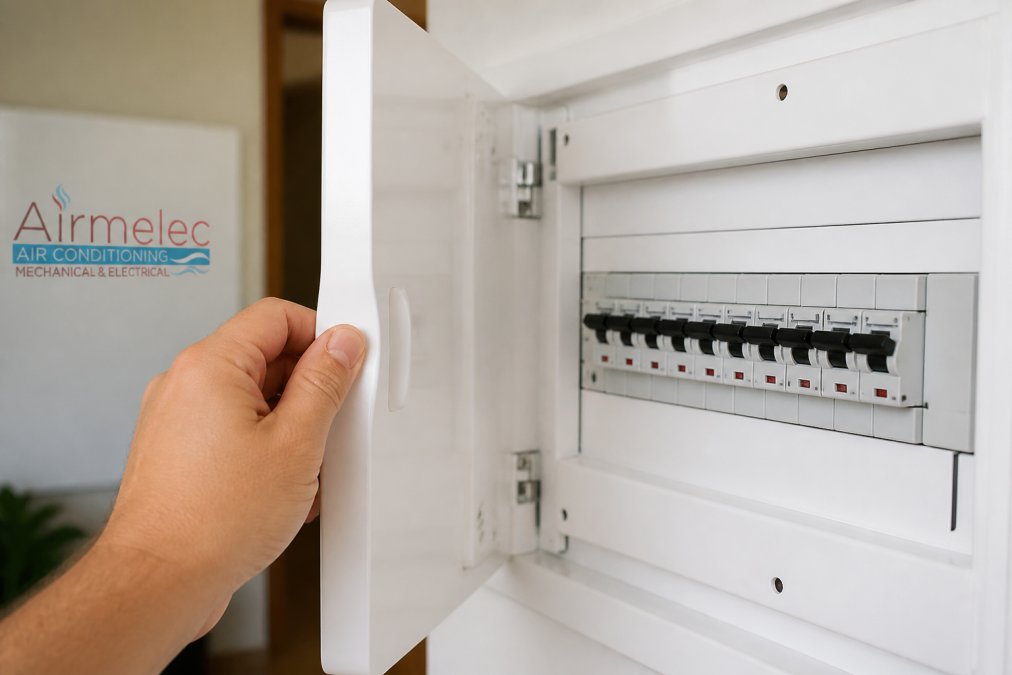
Step-by-step reset procedure
Step 1: Identify the tripped breaker. Open your panel and look for the breaker in the middle position or fully off.
What to do if the breaker trips again immediately
If the breaker trips immediately, stop resetting it. Turn it fully off and do not use that circuit, a short circuit can cause fire. Call a licensed electrician to diagnose the fault safely.
Diagnosing Why Your Breaker Keeps Tripping
Use the following logic tree to identify whether you’re dealing with an overload, short circuit, ground fault, or faulty appliance.
Diagnostic flowchart: step-by-step logic
Step 1: Does the breaker trip immediately when reset with nothing plugged in?
-
Yes → You have a wiring fault (short circuit or ground fault). Turn the breaker fully off and call a licensed electrician. Air Conditioning & Electrical’s team of fully licensed technicians can assist.
-
No → Proceed to Step 2.
-
Yes → The appliance is faulty. Unplug it and test the circuit. If the breaker holds, the appliance needs repair or replacement.
-
No → Proceed to Step 3.
-
Yes → You have an overloaded circuit. Move high-draw appliances to a different circuit.
-
No → Proceed to Step 4.
-
Yes → You may have a ‘ghost trip’ from thermal fatigue or intermittent contact. See the intermittent tripping section below.
-
No → Proceed to Step 5.
-
Yes → You likely have a ground fault. Stop using that circuit and call a licensed electrician. Air Conditioning & Electrical provides expert electrical services.
-
No → Document when trips occur and call a licensed electrician with this information. Air Conditioning & Electrical’s highly trained electricians are available for diagnosis.
Identifying which circuit is affected
Label your electrical panel by turning on lights and appliances in each room, then flipping breakers one at a time to identify which controls what. Kitchen circuits are more prone to ground faults; bedroom circuits to overloads.
Understanding AFCI and GFCI breaker behaviour
AFCI (Arc Fault Circuit Interrupter) breakers detect dangerous electrical arcs and trip faster than standard breakers. They’re required in bedrooms, living areas, and kitchens. Repeated AFCI trips usually indicate a damaged appliance cord, loose connection, or worn wiring, not overload.
The ‘ghost trip’ phenomenon: intermittent tripping
A ‘ghost trip’ occurs when breakers trip hours or days after use, often from thermal fatigue. The bimetallic strip inside can develop a ‘memory’ over years, becoming more sensitive and tripping at lower temperatures.
When to Call an Emergency Electrician
Call an electrician immediately if:
- The breaker trips repeatedly even after you’ve reduced load
- You smell burning plastic or insulation near the panel
- You see scorch marks, discolouration, or melting around outlets
- The breaker feels hot to the touch
- Water has entered the electrical panel
- You suspect a short circuit or ground fault
- The panel itself is damaged or corroded
- You’ve had an electrical shock from an outlet or appliance
These signs indicate a serious fault that can cause fire or injury. Air Conditioning & Electrical’s fully licensed technicians have the equipment and expertise to diagnose and repair the problem safely.
Safety Precautions and Prevention
Your electrical panel contains live current even when breakers are off. Understanding the risks and following preventative practices will help you avoid dangerous situations.
Inside the electrical panel: what you must never touch
The electrical panel is not a DIY space. Even with the main breaker off, the main service lines carry full voltage and can cause severe injury or death.
Environmental protection: keeping your panel safe
Keep the area dry. If your panel is in a basement, laundry room, or garage, ensure it’s not exposed to standing water, condensation, or high humidity. If water has entered the panel, call a licensed electrician immediately. Air Conditioning & Electrical provides expert electrical services.
Testing and maintaining GFCI protection
GFCI outlets and breakers are your first line of defence against electrocution. Test them regularly:
- Locate GFCI outlets in your kitchen, bathroom, laundry, and outdoor areas.
- Press the Test button on the outlet. The outlet should cut power instantly (you may hear a click).
- Press Reset to restore power.
- Perform this test monthly. If the outlet does not cut power when you press Test, it has failed and must be replaced.
Preventing overloads: load management
Spread high-draw appliances across different circuits. A kettle, microwave, and toaster should not all be plugged into the same circuit. Check your panel directory to see which outlets are on which breaker, then distribute heavy loads.
Breaker replacement and upgrades
If your home frequently trips breakers despite your efforts to manage load, you may need additional circuits or a panel upgrade. This is not a DIY job.
Signs you need an upgrade:
- Breakers trip multiple times per week
- You’re using extension cords or power boards throughout your home
- You’ve recently added high-draw appliances (air conditioner, electric vehicle charger, heat pump) and the panel can’t handle them
- Your panel is more than 40 years old (older panels have lower capacity and less reliable breakers)
Critical safety rule: never upsize a breaker
A common and dangerous mistake is replacing a tripped breaker with one rated for higher amperage (e.g., replacing a 15 A breaker with a 20 A breaker). This creates a serious fire risk.
Frequently Asked Questions
What is the most common cause of a tripped circuit breaker?
Overloaded circuits are the most frequent culprit. When too many high-draw appliances run simultaneously on the same circuit, the amperage exceeds the circuit’s capacity, triggering the breaker’s thermal trip mechanism. A single high-power device like a compressor or motor can also overload a circuit. Identifying which appliances are connected to the affected circuit helps you redistribute load and prevent recurring trips.
How do I know if my circuit breaker needs to be replaced?
A breaker may need replacement if it trips repeatedly even after you’ve reduced the load, if it feels hot to the touch, or if it won’t stay in the reset position. Worn-out breakers lose their ability to respond correctly to overload and fault conditions, creating a safety hazard. If you’ve ruled out overloaded circuits and appliance faults, Air Conditioning & Electrical’s licensed electricians can inspect your electrical panel to determine whether replacement is necessary.
Is it dangerous if my circuit breaker trips frequently?
Frequent tripping indicates an underlying electrical problem that requires diagnosis. While the breaker itself is functioning by cutting power to prevent hazards, the root cause, whether overload, short circuit, ground fault, or faulty wiring, poses a genuine safety risk. Repeated trips can also indicate deteriorating insulation or high-resistance connections that may lead to arcing or fire. Have a qualified electrician investigate promptly rather than ignoring the pattern. Air Conditioning & Electrical’s team of fully licensed technicians can assist.
Can I reset my circuit breaker myself, or should I call a professional?
Resetting a tripped breaker is safe to do yourself: switch the toggle fully to the off position, then back to on. However, if the breaker trips again immediately or repeatedly, do not keep resetting it. This signals a fault condition that requires professional diagnosis. Air Conditioning & Electrical’s licensed electricians can identify whether the problem is an overloaded circuit, short circuit, ground fault, or faulty appliance, and recommend the appropriate fix to restore safe operation.