
Last Updated: October 30, 2026
Quick Summary
Smart thermostats can be worth it in an older home, but only once you confirm your heating system and wiring can support them. Many older systems need a C-wire or a compatible controller, and drafts or poor insulation limit any savings. In a sealed, serviced home with irregular occupancy, the payback is more likely to be reasonable.
- Check your wiring first, especially whether you have a C-wire for constant power.
- Confirm compatibility with your boiler, furnace or heat pump before buying.
- Fix draughts and insulation first, as they limit how much any thermostat can save.
- In a multi-zone home, one smart thermostat may only control a single zone.
- Get a licensed assessment before you buy to confirm what your home needs.
Table of Contents
- What a Smart Thermostat Does and How It Differs From a Standard Model
- Smart Thermostat vs Programmable Thermostat: Which Suits an Older Home
- Smart Thermostat Compatibility With Old HVAC Systems
- Smart Thermostat Installation Requirements for Older Homes
- Realistic Smart Thermostat Energy Savings and Payback
- When a Smart Thermostat Is Not the Best First Upgrade
- Booking an Assessment Before You Buy a Smart Thermostat
- Frequently Asked Questions
What a Smart Thermostat Does and How It Differs From a Standard Model
A smart thermostat is a Wi-Fi connected controller that manages your heating and cooling from a phone, tablet or computer. Unlike a basic dial or manual unit, it can learn your routines, adjust temperatures automatically and show you how the system is running.
Most smart models share a few core features:
- Remote control: change settings from an app while you are away
- Scheduling: set heating and cooling times that adjust without manual input
- Learning features: some models track your habits and suggest changes
Many homeowners in older houses assume a smart thermostat is simply a fancier version of the one already on the wall. That is only partly true.
Smart Thermostat vs Programmable Thermostat: Which Suits an Older Home
A programmable thermostat follows a fixed schedule you set once. A smart thermostat adds connectivity, adaptive controls and remote access on top of scheduling.
For an older home, the choice often comes down to these points:
- A programmable model is usually simpler to fit and cheaper to buy, and it may suit a home with a basic system and limited wiring.
- A smart model offers more control and data, but it may need a common wire (C-wire) or a compatible system to work properly.
- Either option will do little if the home loses heat quickly through drafts or poor insulation.
If your system is old and your wiring is unclear, a programmable thermostat is often the lower-risk choice. A smart unit makes more sense once you know your system can support it.
Smart Thermostat Compatibility With Old HVAC Systems
Compatibility is the first real hurdle for older homes, and it is where most buying mistakes happen. Many older heating and cooling systems were never designed for the low-voltage control signals that modern thermostats expect, so the question is not simply whether a smart model has the features you want but whether your system can talk to it. The most common electrical problems found in older homes can also affect the wiring and power a smart thermostat relies on.
Start by identifying what you actually have. Older homes commonly run one of these setups:
- Forced-air gas or electric furnaces with a single thermostat and ducted distribution
- Ducted split systems with a central controller
- Boilers feeding radiators or underfloor loops, often with zone valves and separate room controls
Each type uses different control signals. A thermostat that suits a forced-air furnace may not control a boiler with zone valves, and a model designed for a heat pump with auxiliary heat may not support a single-stage boiler at all.
Check the wiring before you check the features
Before buying, look at the wires connected to your current thermostat:
- Count the wires and note the terminal labels (R, W, Y, G, C, O/B and so on)
- Look for a C-wire, a constant 24V power connection, because most smart thermostats need one to run without batteries
- Note whether the system is low-voltage (typically 24V) or line-voltage (mains), because line-voltage systems such as some electric in-slab heaters need a different class of controller entirely
A common mistake is buying a smart thermostat based on its features alone, then finding it will not power up or control the system correctly.
Wiring, common wires and adapters
Smart thermostats usually need a constant power source. Many get it from a C-wire. If your older home lacks one, there are three common routes:
- Run a new wire from the system to the thermostat location, the most reliable option, but it may involve wall and ceiling access.
- Use a power adapter or C-wire kit supplied by the thermostat maker, which draws power from the system without a dedicated wire.
- Choose a model that runs on batteries or a local power supply, which avoids the C-wire requirement but may limit features.
Each option adds cost and complexity, and the right choice depends on your system type and access. Confirm the adapter is compatible with your specific model and system before buying.
Boilers, radiators and zoned heating
Boilers with radiators need particular care. Some smart models work well with boiler controls, but others do not support the hot-water or zoning setup in older properties. Key questions include:
- Is the boiler controlled by a simple on/off signal, or does it use a more complex modulating control?
- Are there zone valves serving different areas, and does the thermostat need to control one zone or the whole system?
- Are there separate room controls or thermostatic radiator valves that already manage temperature room by room?
In a multi-zone older home, a single smart thermostat may only control one zone, so the savings and comfort benefits are limited unless the other zones are also addressed. Confirm compatibility with the boiler, the zone valves and the radiator layout before you commit.
Photograph your current thermostat wiring and the model plate on your boiler or furnace before you shop. A licensed technician can usually confirm compatibility from those two images alone, which saves a wasted purchase.
Smart Thermostat Installation Requirements for Older Homes
Installation in an older home often goes beyond swapping one unit for another. Electrical work, wall repairs and system checks may all be needed.
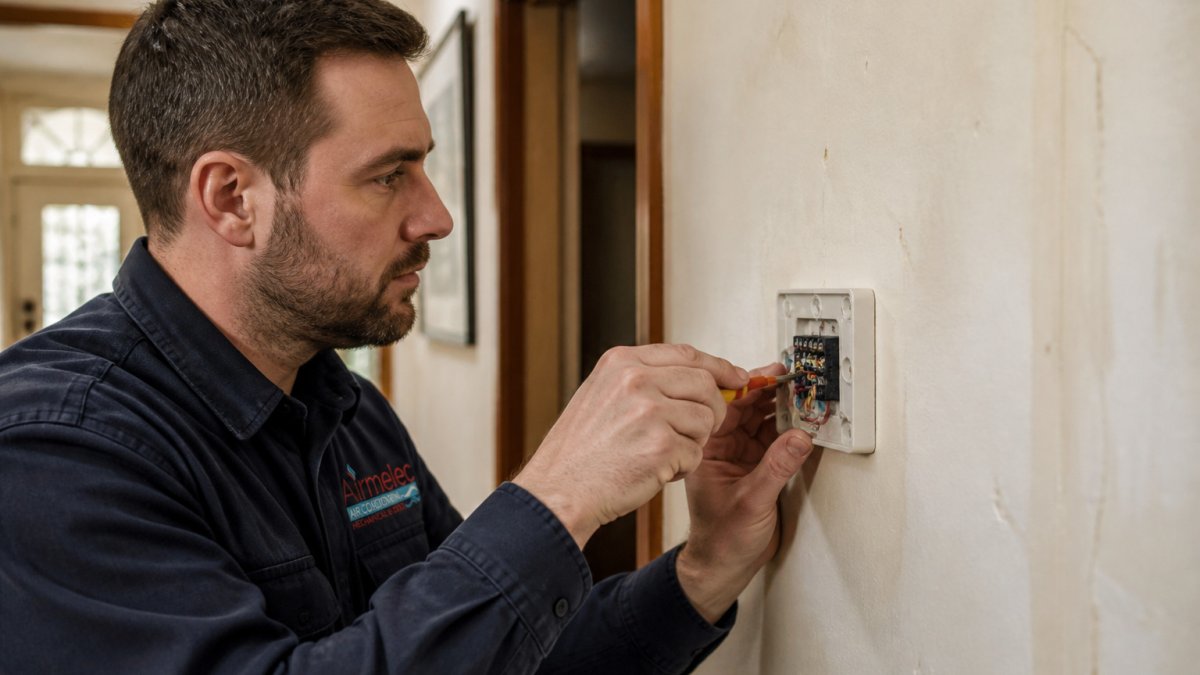
Common requirements include:
- Checking that the existing electrical supply can handle the controls and the HVAC load
- Confirming the wiring is in good condition before connecting anything new
- Assessing whether the wall location suits sensors and remote access
Some homeowners attempt a DIY installation to save money. This can be risky with mains wiring, and a poor connection can damage equipment or create a safety hazard. A licensed professional can confirm what your home needs before any new device goes in.
Realistic Smart Thermostat Energy Savings and Payback
Smart thermostats can reduce energy use by adjusting temperatures when rooms are empty or when you are asleep. The size of that saving depends on your habits, your insulation, your fuel type, your climate and how well the system runs.
Rather than quoting a single average, it helps to think in scenarios. The three below are illustrative patterns, not promises, and your own figures will depend on your home and tariff.
Scenario 1: Well-sealed older home, modern boiler, disciplined schedule
If the home has reasonable insulation, the boiler has been serviced and the household already sets back the temperature overnight and when out, a smart thermostat mainly adds convenience and finer scheduling. The additional saving over a programmable thermostat is usually modest, and payback may stretch over several years. The value here is comfort and remote control more than bill reduction.
Scenario 2: Drafty older home, older boiler, irregular occupancy
This is where a smart thermostat can do more, but only if the home is also air-sealed and the boiler is running efficiently. If the household is out at different times each day, occupancy sensing and remote adjustment can cut wasted heating. Even so, a leaky home loses heat quickly, so the thermostat cannot compensate for the building fabric. The realistic pattern is a moderate saving that improves once drafts and insulation are addressed.
Scenario 3: Multi-zone home with radiators and separate room controls
In a zoned older home, a single smart thermostat may only control one zone. Savings are limited unless the other zones are also managed, and the cost of adding controls to each zone can outweigh the benefit. In this scenario, radiator balancing and thermostatic radiator valves are often a better first spend than a single smart controller.
How to work out payback
Payback depends on three factors: the purchase price, the installation cost (which may be higher in an older home), and your annual energy bill. A practical method is:
- Get a clear quote for the full job, including any adapter, wiring or wall repair.
- Estimate your annual heating and cooling spend from your bills, separating heating from other uses where possible.
- Apply a conservative saving range, for example, a smaller percentage if your home is drafty or your habits are already efficient, and a larger one if occupancy is irregular and the system is in good order.
- Divide the total cost by the annual saving to see how many years payback would take.
If the payback period is longer than you plan to stay in the home, or longer than the expected life of the thermostat, the case is weaker. Working this out before you buy is a sensible step, and comparing it with the cost of air sealing, insulation or a boiler service can show which spend may deliver a better return in an older home.
A smart thermostat is most likely to pay back in an older home when the building is reasonably sealed, the heating system is serviced, and occupancy is irregular. In a drafty home with an inefficient boiler, fix the fabric and the system first, the thermostat will then have something to control.
The article sets out three illustrative scenarios, each showing how much a smart thermostat is likely to help depending on the home and its habits.
| Scenario | Home and habits | Likely outcome |
|---|---|---|
| Well-sealed home | Reasonable insulation, serviced boiler, disciplined schedule | Modest extra saving; value is comfort and control |
| Drafty home | Drafts, older boiler, irregular occupancy | Moderate saving once drafts and insulation are fixed |
| Multi-zone home | Radiators and separate room controls | Limited saving; radiator valves may come first |
When a Smart Thermostat Is Not the Best First Upgrade
A smart thermostat is not always the right first step. In some older homes, the biggest gains come from other work.
Consider these alternatives first if:
- The home has major draughts, poor insulation or unsealed windows
- The heating or cooling system is old, inefficient or frequently breaking down
- The electrical wiring is outdated or unsafe
Fixing these issues first can make any thermostat more effective. It can also stop you spending money on controls that cannot do their job in a poorly performing system.
Booking an Assessment Before You Buy a Smart Thermostat
The safest way to decide is to have your home and system assessed before you buy. A proper assessment checks your wiring, system type, insulation and electrical capacity, and tells you which options suit your home.
At Air Conditioning & Electrical, we are a locally owned and operated team of fully licensed technicians.
Get a quote today to find out whether a smart thermostat is worth it for your older home.
Frequently Asked Questions
Will a smart thermostat work with an older heating or cooling system?
Often, but not always. Most smart thermostats need a compatible system type, such as forced-air, ducted reverse-cycle or a supported boiler arrangement. Older systems may use wiring that does not match what the thermostat expects, so checking the existing controls and wiring before buying is the sensible first step. A licensed technician can confirm compatibility on site and advise whether an adaptor or a different model is needed.
Do smart thermostats need a common wire?
Many do. A common wire, usually called the C-wire, gives the thermostat a constant power supply so its Wi-Fi and display stay active. Older homes often lack one. Some models work without a C-wire by drawing power in other ways, while others need one fitted. Whether one is needed depends on the specific model and the existing wiring, so check the manufacturer’s requirements before installing.
Can a smart thermostat save energy in an older home?
It can, mainly by reducing heating and cooling run time when the house is empty or asleep. Savings depend heavily on insulation, drafts, zoning and how the system is used. An older home with poor insulation may see smaller gains than a newer, well-sealed one, so the savings should be treated as an estimate rather than a guarantee. Sealing drafts and servicing the system first often improves results more.
Is a programmable thermostat a better choice for an older home?
Sometimes. A programmable thermostat is usually cheaper and simpler to fit, and it can handle a basic daily schedule well. A smart model adds remote access, learning features and usage reports, which may suit households with irregular routines. For an older home with an unreliable or non-standard system, the simpler programmable model may be the lower-risk choice, and the decision should follow the existing equipment.
