
Last Updated: November 1, 2026
Quick Summary
An air conditioner leaking water inside is usually a blocked condensate drain, dirty filter, frozen coil or damaged drain pan. Switch the unit off at the wall, then check the outdoor drain outlet and clean or replace the filter to stop the leak.
- A blocked condensate drain is the single most common cause of indoor leaks.
- Check the air filter monthly in heavy use and clean or replace it.
- Flush the drain line every three months in humid weather.
- Never run a leaking unit; switch it off until the cause is fixed.
- Call a licensed technician if ice forms, the pan is cracked or water nears electrics.
Table of Contents
- Why Is Your Air Conditioner Leaking Water Inside?
- Air Conditioner Leaking Water Causes: What to Check First
- How to Stop the Leak: Immediate Safety and Water Damage Steps
- Clearing a Blocked Air Conditioner Drain
- Can I Run My Air Conditioner If It Is Leaking Water?
- Air Conditioner Water Leak Repair: DIY Limits and When to Call a Technician
- Book a Licensed Technician to Find and Fix the Leak
- Frequently Asked Questions
Why Is Your Air Conditioner Leaking Water Inside?
An air conditioner leaking water inside is usually a drainage problem, not a cooling problem. Your system pulls moisture out of the air, and that water has to go somewhere. When it can’t, it ends up on your floor.
Most indoor leaks trace back to a handful of causes, and you can check them yourself before ringing anyone.
Normal Condensation vs a Real Leak
Some moisture is normal. A split system removes humidity from your rooms, and that condensation collects in a drain pan and flows out through a drain line.
A real leak looks different. Watch for:
- Water pooling under the indoor unit
- Damp patches on carpet or ceiling
- A drip that keeps going after the unit switches off
If you see any of these, treat it as a leak. The full guide on split system leaks covers each cause in more depth.
When a Leak Is Urgent
Most leaks are slow. Some are not. Switch the unit off and call a technician straight away if:
- Water is near power points, cabling or the switchboard
- The ceiling is sagging or stained
- The leak started suddenly and is flowing steadily
Water and electricity do not mix. Never poke around inside a wet unit that is still connected to power.
Air Conditioner Leaking Water Causes: What to Check First
The most common air conditioner leaking water causes are a blocked drain, a dirty filter, a frozen coil or a damaged drain pan. But the fastest way to stop the leak is to match what you are seeing to the likely cause before you start pulling panels off.
Use this symptom-led check to narrow it down. Work through it in order, because the first two checks are safe for most homeowners and cost nothing.
Symptom-to-Cause Decision Tree
Water drips steadily while the unit runs, and the indoor unit is otherwise normal.
Start with the condensate drain.
Water appears only after the unit has run for a while, and cooling feels weaker than usual.
Suspect restricted airflow or a frozen evaporator coil.
Water sits in the drain pan but the drain line is clear.
Inspect the pan itself.
Water appears only in humid weather and the amount is small.
Some condensation is normal.
System-Specific Differences
The same symptom can mean different things depending on the system type.
- Central split systems usually have the indoor coil and drain pan in the roof space or a ceiling cassette. A leak often shows up as a ceiling stain before you see water at the unit. Access is harder, so drain flushing is best done by a technician during routine maintenance.
- Ductless mini-splits have the drain pan and drain line inside the wall-mounted head. The drain outlet is often a small pipe running down the outside wall. These are the easiest to check and flush yourself.
- Window units rely on a slight backward tilt so condensation drains to the outside. If the unit is level or tilted inward, water will pool inside the room. Check the tilt before assuming a blocked drain.
What Normal Condensation Looks Like
Not every drip is a fault. On a humid day, a split system can produce a steady trickle from the outdoor drain line, and that is normal. What is not normal is water inside the room, water staining the ceiling, or a drip that continues after the unit switches off.
While you’re inspecting, keep an eye out for odd smells too. Our guide on why your air conditioner smells covers that side of things.
Dirty Air Filter and Restricted Airflow
A clogged filter chokes airflow across the coil. The coil gets too cold, frosts up, then thaws into the drain pan faster than the drain can carry it away.
Check the filter monthly in heavy use. Clean or replace it, and the leak often stops on its own.
Frozen Evaporator Coil and Thawing Ice
Ice on the indoor coil is a warning sign. It usually means restricted airflow or low refrigerant. When the ice melts, water overflows the pan.
Switch the unit to fan mode or turn it off and let it thaw. If ice returns after a filter clean, you need a technician, because low refrigerant is not a DIY fix.
Damaged or Overflowing Drain Pan
A cracked, rusted or misaligned drain pan will leak no matter how clean the drain is. Look for standing water in the pan, rust flakes or a pan that sits at the wrong angle.
Pan damage usually means replacement. That’s a job for a licensed technician.
Match what you are seeing to the likely cause before you start pulling panels off.
| What you see | Likely cause | What to do |
|---|---|---|
| Steady drip while unit runs, unit otherwise normal | Blocked condensate drain | Check outdoor drain outlet, flush the line |
| Water after running a while, weaker cooling | Clogged filter or frozen coil | Check and clean or replace the filter |
| Ice on indoor coil or refrigerant lines | Coil icing from low refrigerant or airflow restriction | Thaw with unit off, clean filter, call technician if ice returns |
| Water in pan but drain line clear | Cracked, rusted or misaligned drain pan | Pan usually needs replacement by a technician |
| Water at ceiling or running down a wall | Installation or tilt issue, or blocked drain in wall cavity | Switch off and call a technician |
| Small amount only in humid weather | Normal condensation | No action needed if water stays outside the room |
How to Stop the Leak: Immediate Safety and Water Damage Steps
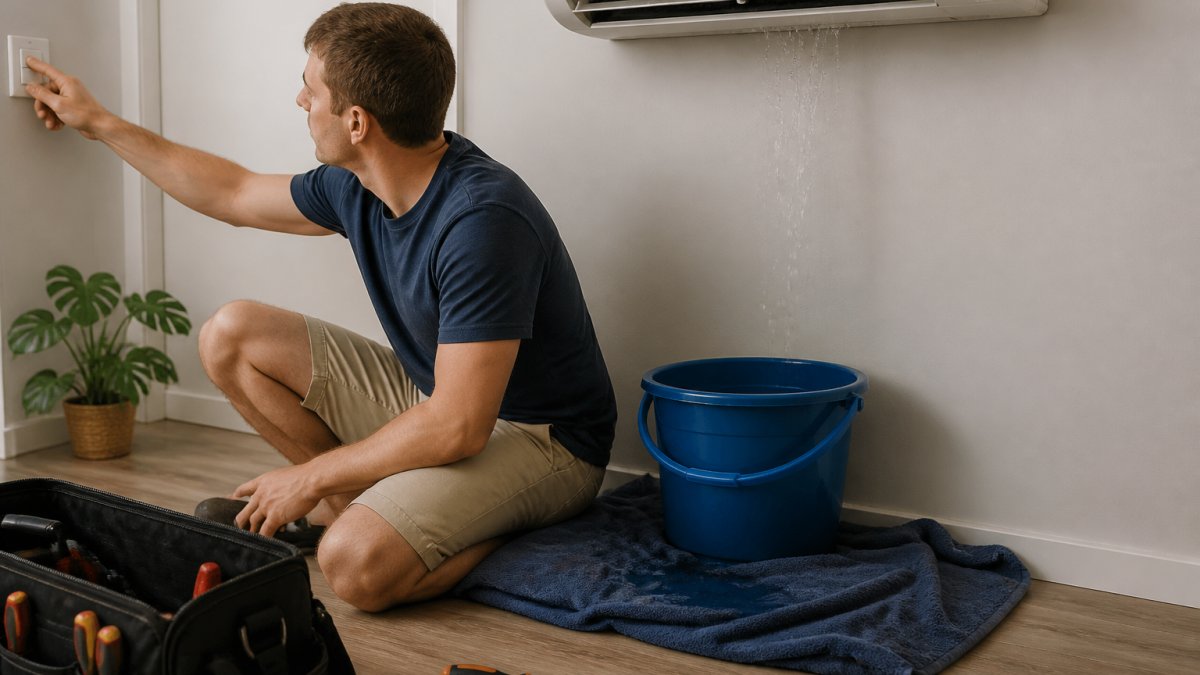
Stop the leak first, then worry about the cause. Turn the unit off at the wall, protect your floors and get the water out before it spreads.
Here’s the order we recommend:
- Switch off the unit at the wall. Not just the remote.
- Kill power at the switchboard if water is anywhere near electrical fittings.
- Place towels and a bucket under the indoor unit.
- Mop up standing water and dry the area with a fan.
- Check for water near power points, cables or ceiling fixtures. If found, call an electrician.
- Leave the unit off until the cause is found.
Watch out: mopping up and restarting the unit without fixing the cause just moves the problem. Water damage and mould build quietly behind wall linings.
Clearing a Blocked Air Conditioner Drain
A blocked air conditioner drain is the single most common cause of indoor leaks. Dust, algae and debris build up in the condensate line until water backs up into the pan and overflows.
Here’s how to clear it safely:
- Turn the unit off at the wall.
- Find the drain line, usually a small pipe running from the indoor unit to outside.
- Check the outdoor drain outlet for visible blockages like leaves or insect nests.
- If you can reach the drain pan, look for sludge or standing water.
- Flush the line gently with water or use a wet/dry vacuum at the outdoor outlet.
- If water still won’t flow, stop. The blockage may be inside the wall or unit.
Flush the drain as part of routine maintenance, ideally every three months in humid weather.
Can I Run My Air Conditioner If It Is Leaking Water?
No. If your air conditioner is leaking water, switch it off until the cause is fixed.
There is one exception. If the leak is a slow drip from condensation and you’ve cleared the drain, a short run to test it is fine.
If you’re weighing up whether the unit is worth keeping, our guide on signs it’s time to upgrade helps you decide.
Air Conditioner Water Leak Repair: DIY Limits and When to Call a Technician
You can handle filter cleaning, drain flushing and mopping up. Everything else belongs to a licensed technician. The useful question is not just when to call, but what the repair involves and how to tell whether it worked.
What You Can Safely Do Yourself
These checks are safe for most homeowners and cost nothing but time:
- Switch the unit off at the wall and at the switchboard if water is near electrical fittings.
- Clean or replace the air filter.
- Check the outdoor drain outlet for visible blockages like leaves or insect nests.
If the leak stops after one of these steps, you have likely fixed it. Run the unit for a short test and watch the drain outlet.
What Requires a Licensed Technician
Call a professional if:
- The leak returns after cleaning
- Ice forms on the indoor coil
- The drain pan is cracked or rusted
Air conditioner water leak repair on refrigerant lines, coils or pans is not a DIY job. Getting refrigerant work wrong can damage the system. Refrigerant work must be carried out by a licensed technician.
Repair or Replace?
A single blocked drain or dirty filter is a maintenance fix. A cracked drain pan, a failed condensate pump or a coil that keeps icing points to a repair. Repeated leaks on an ageing system can mean the repair is no longer worth it.
If the unit is more than ten years old and has had repeated leaks, ask the technician for a repair-versus-replace comparison before authorising work. Our guide on signs it’s time to upgrade helps you weigh that decision. Catching these issues early prevents extensive water damage, so stay vigilant for subtle signs of leaking AC that often precede a total system failure.
What the Technician Should Check
A proper diagnosis is not just clearing the drain. Ask whether the technician will:
- Flush and test the full condensate line, not just the visible section
- Check the drain pan for cracks and correct slope
- Measure airflow and check the filter and return air path
If DIY is ruled out, here’s how to find same day air conditioning help when you need it fast. A licensed technician can trace the leak, verify the repair and check the whole system at the same time.
Before the technician arrives, take photos of the leak and note when it happens, during running, after switch-off, or only in humid weather. That symptom pattern shortens the diagnosis and often saves a return visit.
Book a Licensed Technician to Find and Fix the Leak
A leak that keeps coming back usually has a cause you can’t see from the floor. Coil damage, low refrigerant and installation faults all need proper diagnosis.
At Air Conditioning & Electrical, our fully licensed technicians find the cause, not just the puddle. We handle repairs, maintenance and full system checks across the region.
Don’t let a small drip turn into a ceiling repair.
Frequently Asked Questions
How do I stop my air conditioner from leaking water inside?
Turn the unit off at the wall first, then mop up any water and check whether the air filter is clogged or the indoor unit is tilted. If the filter is dirty, clean or replace it and let the system dry before restarting. If water still appears, the condensate drain line is likely blocked or the drain pan is damaged. A licensed technician can clear a blocked air conditioner drain and confirm the leak is fixed rather than just slowed.
Can I still run my air conditioner if it is leaking water?
Switch it off until you know why it is leaking. Running a leaking unit can soak ceilings, carpets and electrical fittings, and if the evaporator coil is frozen, continued operation makes the ice worse. Once the filter is clean and the drain is clear, a short test run is fine. If water returns, leave the unit off and book a technician for air conditioner water leak repair.
Can a blocked drain cause an air conditioner to leak inside?
Yes. Condensation collects in the drain pan and leaves through the condensate drain line. Dust, mould and debris can clog that line, so water backs up and overflows into the room. Flushing the drain with water or gently clearing the outlet often solves it. If the blockage keeps returning, a technician can inspect the full drainage path and check the pan for cracks.
When should I call a technician about an air conditioner water leak?
Call a licensed technician if water returns after you have cleaned the filter and cleared the drain, if the drain pan is cracked or rusted, if the coil keeps freezing, or if the leak sits near power points and wiring. Persistent leaks can point to low refrigerant, incorrect installation or a tilted indoor unit, and those need proper diagnosis rather than a DIY patch.
