
Table of Contents
- Why Electrical Compliance Matters in HVAC Installations
- Faulty Wiring and Aged Insulation in Air Conditioning Systems
- Loose Connections and Poor Terminations
- Air Conditioning Circuit Breaker Keeps Tripping: Causes and Solutions
- Air Conditioner Electrical Requirements and Sizing
- HVAC Electrical Safety Checklist for Installations and Inspections
- Electrical Safety Certificate for Air Conditioning Installation
- Common Red Flags That Indicate Non-Compliance
- Frequently Asked Questions
Last Updated: October 7, 2026
Why Electrical Compliance Matters in HVAC Installations
Electrical safety in HVAC systems is a legal requirement. Common electrical compliance issues in HVAC installations risk fires, shock, equipment damage and liability.
Common electrical compliance issues in HVAC installations stem from rushed work, outdated standards or shortcuts, and often go unnoticed until something fails.
Most are preventable with proper planning, qualified installation and regular inspection.
Faulty Wiring and Aged Insulation in Air Conditioning Systems
Faulty wiring and aged insulation are among the most dangerous HVAC electrical defects.
Aged insulation typically appears as:
- Brittle, cracked, or peeling outer coating
- Discoloured or darkened wire sheathing
- Visible copper or bare conductor showing through
Systems installed 15-20 years ago often have insulation at the end of its lifespan. Newer installations can develop faults through poor workmanship, heat cycles or mechanical damage.
The fix depends on severity: minor damage may need only that run replaced, while widespread deterioration usually means replacing the entire branch circuit or feeder cable.
Never attempt to repair damaged insulation with electrical tape or other temporary measures. This creates a false sense of security and significantly increases fire risk. Faulty wiring must be replaced, not patched.
Loose Connections and Poor Terminations
Loose connections are a silent killer. A connection that isn’t tight enough creates resistance and heat, which over time can melt insulation, corrode terminals and cause a fire.
Poor terminations happen when:
- Wires aren’t fully inserted into terminal blocks or breaker slots
- Crimp connectors are applied without proper pressure
- Bolted connections aren’t tightened to specification
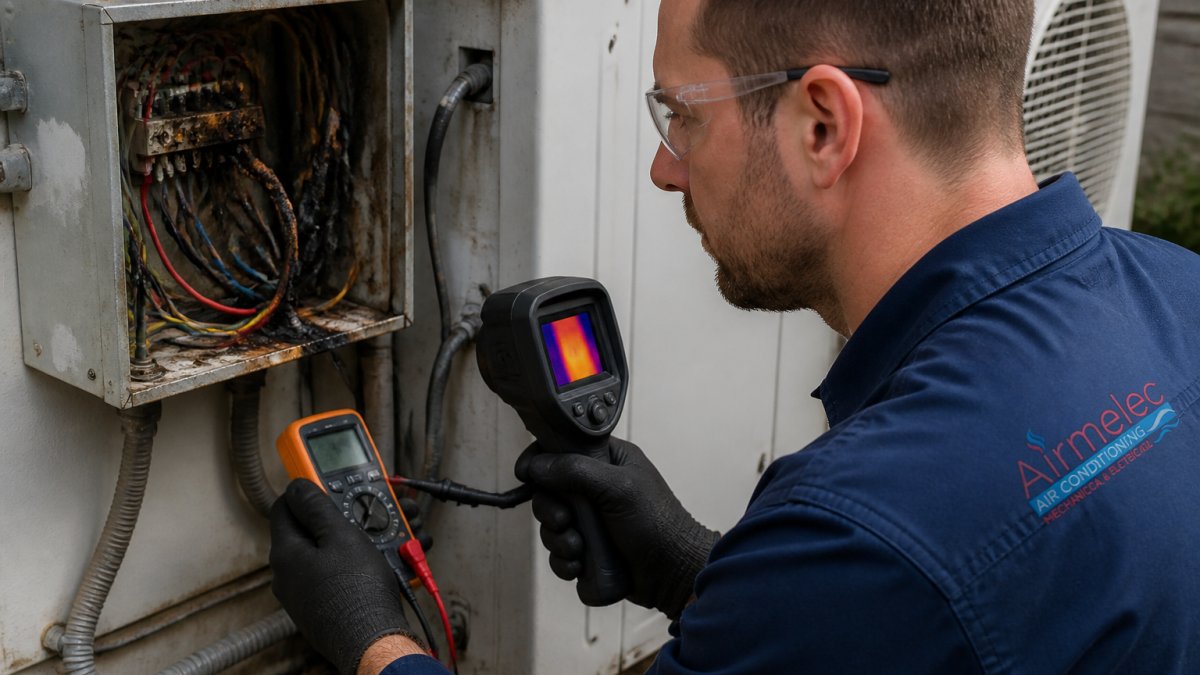
These issues are invisible to the untrained eye; a visual inspection alone won’t catch them. A qualified electrician uses a multimeter and thermal imaging to detect them before they become dangerous.
Common locations where loose connections occur in HVAC electrical work:
- Air conditioning unit disconnect switch terminals
- Circuit breaker connections at the main panel
- Contactor coil terminals
Request a thermal imaging scan as part of your HVAC electrical safety inspection. Loose connections generate heat that shows up clearly on thermal images, often before you’d notice any other warning signs.
Air Conditioning Circuit Breaker Keeps Tripping: Causes and Solutions
A breaker that trips repeatedly is doing its job: interrupting the circuit before a fault becomes a fire. In HVAC circuits, the trip pattern usually points to the fault.
Read the trip pattern first
Before touching anything, note how the breaker behaves. The pattern narrows the diagnosis considerably:
- Trips immediately on reset, before the unit starts, a hard short circuit or a ground fault in the wiring, disconnect or contactor.
- Trips a few seconds to minutes after the compressor starts, an overload condition: locked rotor, failing compressor, or a circuit sized too tightly for the actual running load.
- Trips only on hot days or after long run times, thermal overload from a weakening compressor, a dirty condenser coil raising head pressure, or a breaker that has drifted out of calibration.
HVAC-specific causes worth checking
| Cause | What is actually happening | Correct response |
|---|---|---|
| Loose termination at the isolator or contactor | Resistance at the joint generates heat, which raises current draw and can carbonise the terminal | Isolate, inspect and re-terminate to the manufacturer’s torque specification |
| Moisture in the outdoor isolator | Rain or condensation bridges live parts to earth, producing a ground fault | Replace the enclosure with the correct IP rating and reseal cable entries |
| Failed start or run capacitor | Compressor draws locked-rotor current on every start | Test capacitance against the nameplate value and replace if out of tolerance |
| Seized or failing compressor | Motor draws far above rated load current | Confirm with a clamp meter against the nameplate rated load amperage |
| Undersized circuit or breaker | Breaker rating below the unit’s maximum overcurrent protection, or cable too small for the run | Recalculate from the nameplate and rectify the circuit |
| Shared circuit with other loads | Non-HVAC loads push the circuit over its rating | Provide a dedicated circuit as required for the equipment |
The diagnostic sequence a competent electrician follows
- Isolate and lock out the circuit at the switchboard, then verify dead with a proven tester before opening any enclosure.
- Record the nameplate data, rated load amperage, maximum overcurrent protection, voltage and phase, so every later measurement has a reference point.
- Inspect terminations at the breaker, isolator, contactor and compressor terminals for discolouration, pitting or heat damage.
- Measure insulation resistance on the circuit and motor windings to identify breakdown to earth.
- Clamp the running current and compare it with the nameplate figure; a reading well above rated load amperage points to a mechanical or compressor fault rather than an electrical one.
- Thermal-scan the terminations under load to find joints heating before they fail.
- Rectify the root cause, then re-test and document the results.
Never respond to a tripping breaker by fitting a larger breaker. The breaker rating is matched to the cable’s current-carrying capacity and the equipment’s maximum overcurrent protection. Upsizing it removes the protection the circuit depends on and turns a nuisance trip into a fire risk.
A tripping breaker is a symptom, not a fault. The compliance issue is not the trip, it is any attempt to silence it without identifying and correcting the underlying defect. Ask for the test results, not just the repair.
If the breaker trips again after a reset, stop. Repeated resetting into a known fault stresses the compressor, contactor and cable insulation, and risks arcing at a weakened terminal.
Air Conditioner Electrical Requirements and Sizing
HVAC equipment isn’t wired like a general-purpose circuit. The nameplate dictates the design, and every component, cable, breaker, isolator and protective device, must match it. Getting this wrong is a common compliance failure.
Start with the nameplate, not the marketing brochure
The outdoor unit nameplate carries the figures that govern the installation:
- Rated load amperage (RLA), the current the compressor draws under normal running conditions.
- Maximum overcurrent protection (MOP), the largest breaker or fuse the manufacturer permits for that circuit.
- Minimum circuit ampacity (MCA), the minimum current-carrying capacity the cable must provide.
These figures are set by the manufacturer and referenced by the installation standard, not interchangeable with a rule of thumb.
How the circuit is actually sized
- Conductor size is selected so the cable’s current-carrying capacity is at least the minimum circuit ampacity, with derating applied for ambient temperature, grouping and installation method.
- The protective device is selected not to exceed the maximum overcurrent protection on the nameplate, while still protecting the cable.
- Voltage drop is checked over the actual cable run. A long run to a detached outdoor unit can require a larger conductor than the ampacity calculation alone would suggest.
- The isolator must be rated for the circuit’s voltage and current and be positioned so it is readily accessible and within sight of the equipment it controls.
A worked example: a unit rated 15 A RLA, 18 A MCA and 25 A MOP needs a cable rated for at least 18 A after derating, a device no larger than 25 A, and an isolator rated for the circuit and installed within sight of the outdoor unit. A smaller cable or larger breaker breaks that coordination.
Grounding and bonding
The equipment must connect to the protective earthing system via a continuous earthing conductor sized to the circuit. Metal enclosures, the outdoor unit frame and any metallic raceway must be bonded so a fault to earth operates the protective device quickly. Corroded or missing earthing is common on older or relocated units.
Manufacturer instructions are part of the compliance picture
Standards require equipment to be installed per the manufacturer’s instructions. Specified clearances, cable entries, isolator locations or dedicated circuits sit alongside the wiring rules and are equally enforceable. Keep the manual with the handover documents.
Commissioning checks and recorded results
Before the system is handed over, the following should be verified and recorded:
- Insulation resistance of the circuit and motor windings
- Earth continuity of the equipment earthing conductor
- Polarity and correct connection at the isolator and switchboard
Ask for the commissioning records, not just the certificate. Test results taken at handover give you a baseline to compare against if the system develops a fault later, and they demonstrate that the circuit was verified rather than merely energised.
Sizing is a chain: nameplate figures, then cable, then protective device, then isolator, then earthing. A single weak link, an undersized cable, an oversized breaker, a missing earth, undermines the whole installation regardless of how neatly it is finished.
::: Maintaining this rigorous standard of electrical integrity prevents the premature equipment failure often addressed by Brass Tacks Plumbing Heating & Cooling when they are called to rectify avoidable system malfunctions.
Wiring rules vary between jurisdictions and are updated over time, so confirm the current edition and any local amendments with the relevant electrical safety regulator or a licensed electrician before signing off.
HVAC Electrical Safety Checklist for Installations and Inspections
Use this checklist during new installations or when inspecting existing systems:
Wiring and Insulation
- Insulation is intact, with no visible damage, cracking, or discolouration
- Wires are properly supported and routed, not rubbing against sharp edges
- Cable runs are protected in conduit where required by code
Connections and Terminations
- All connections are tight and show no signs of corrosion or heat damage
- Terminal screws are torqued to specification (not over- or under-tightened)
- Crimp connectors are properly applied with no loose strands
Circuit Protection
- Breaker amperage matches the wire gauge and unit nameplate
- Breaker is sized according to the maximum overcurrent protection rating
- Breaker operates smoothly and trips under fault conditions
Grounding and Bonding
- Equipment grounding conductor is present and continuous
- Grounding electrode conductor is properly sized and connected
- Metal equipment frames are bonded to the grounding system
Installation Workmanship
- Outdoor condenser unit is mounted on a level, stable base
- Disconnect switch is accessible and within sight of the outdoor unit
- Cable entries are sealed to prevent water ingress
Run through this checklist before signing off; a licensed electrician should verify every point.
Electrical Safety Certificate for Air Conditioning Installation
In most jurisdictions, a new HVAC installation requires an electrical safety certificate (often called a Certificate of Electrical Safety or Certificate of Compliance) issued by a licensed electrician, confirming the work meets current standards.
The certificate documents:
- The date of installation and inspection
- The electrician’s licence number and business details
- A description of the work performed
Without a valid electrical safety certificate, you may face:
- Difficulty selling or renting the property
- Insurance claims being denied if an electrical fault causes damage
- Liability if someone is injured due to non-compliant electrical work
Always request the original signed certificate and keep it with your property records. If purchasing a property with a recent HVAC installation, ask the seller for proof.
Common Red Flags That Indicate Non-Compliance
Certain signs indicate non-compliant or unsafe HVAC electrical work. If you notice any, stop using the system and call a licensed electrician immediately.
Visual Red Flags
- Burnt or discoloured wire insulation – indicates overheating from loose connections or overload
- Corrosion on terminals or connectors – suggests moisture intrusion or poor-quality connections
- Exposed copper or bare wires – a direct electrical hazard
Operational Red Flags
- Circuit breaker trips regularly – the system is drawing too much current or there’s a fault
- Burning smell near the electrical panel or outdoor unit – indicates overheating insulation
- Humming or buzzing from the outdoor unit – may signal a loose connection or failing contactor
Documentation Red Flags
- No electrical safety certificate on file – the work may not have been inspected or approved
- Installer cannot provide proof of licence – the work may have been done by an unqualified person
- No record of which breaker or circuit the unit is on – makes troubleshooting and future work difficult
If you see any of these red flags, don’t troubleshoot or repair the system yourself, contact a licensed electrician to inspect and correct the defects.
Electrical compliance in HVAC installations protects your home, your family and your investment.
Frequently Asked Questions
What are the most common electrical compliance issues in HVAC installations?
The most frequent issues include faulty or aged wiring, loose connections, undersized circuits, and poor workmanship during installation. Non-compliant work often involves missing or incorrect earthing, inadequate circuit protection, and failure to follow Australian electrical standards. These defects create fire hazards and electric shock risks. A qualified electrician should inspect all HVAC electrical work to identify and correct these issues before they cause damage or injury.
Does an HVAC installation need an electrical safety certificate?
Yes. Any new HVAC electrical installation must include a Certificate of Electrical Safety (or Certificate of Compliance) issued by a licensed electrical contractor. This document confirms the work meets the relevant Australian electrical standards and is safe for use. The certificate should be provided to the property owner and retained for the life of the installation. Without it, the installation is not legally compliant and may void insurance or create liability issues.
Why does an air conditioning circuit breaker keep tripping?
Circuit breaker tripping usually signals an overloaded circuit, a short circuit, or a ground fault. HVAC systems draw significant current, and if the circuit is undersized for the equipment, the breaker will trip during operation. Other causes include damaged wiring insulation, loose connections causing arcing, or faulty equipment. Have a licensed electrician test the circuit and HVAC system to identify the root cause and correct it safely.
What should be included in an HVAC electrical inspection?
A thorough inspection covers circuit sizing and breaker ratings, earthing and bonding integrity, insulation condition, connection tightness, junction box security, and compliance with relevant Australian standards. The inspector should verify the equipment is correctly rated for the installation, test for voltage drop and current draw, and check that all protective devices function. The inspection should result in a written report documenting any defects and recommended remediation steps.