
Table of Contents
- Why Homeowners Look for Butler Air Alternatives
- What to Look for in Air Conditioning Contractors
- Air Conditioning Installation: What to Expect
- Air Conditioning Maintenance: Keeping Your System Running
- Finding a Licensed Air Conditioning Technician You Can Trust
- How to Choose the Right Alternative for Your Home
- Frequently Asked Questions
Last Updated: October 17, 2026
Why Homeowners Look for Butler Air Alternatives
When your air conditioning fails on a scorching summer day, finding a reliable contractor quickly becomes urgent.
One contractor rarely fits every situation. Some excel at emergency repairs but charge premium rates; others specialise in installations but have longer lead times.
The best choice depends on your immediate need, property type, and whether you’re planning for long-term reliability or addressing an urgent breakdown.
When comparing contractors, ask for their licence number and verify it with the relevant authority. A legitimate technician should provide this without hesitation, it’s a basic trust signal that separates professionals from unqualified operators.
What to Look for in Air Conditioning Contractors
Selecting a contractor isn’t just about price, the cheapest quote often comes with hidden costs, delayed service or incomplete work. Focus on these criteria instead.
Licencing and Qualifications
A licensed technician has completed formal training and passed competency assessments. Verify that any contractor holds current qualifications in refrigeration and electrical work where relevant.
Ask directly: “What licences do you hold?” A professional will answer immediately and encourage you to verify independently; unlicenced operators often avoid the question or respond vaguely.
The stakes are real: poor electrical work can create fire hazards, and improper refrigerant handling damages the environment and voids warranties.
Never hire a technician who cannot produce current licence credentials. This is the single biggest red flag in the industry. An unlicenced operator may seem cheaper upfront, but you’re liable for any damage or safety issues they cause.
Service Availability and Response Times
Emergency breakdowns happen outside business hours. When your air conditioning fails in January heat, a contractor who answers at 6 p.m. on a Friday is worth far more than one who returns calls on Monday.
Ask these specific questions:
- Do you offer same-day or next-day emergency service?
- What are your response time guarantees during peak summer months?
- Do you charge extra for after-hours callouts, and if so, how much?
- Are you available on weekends and public holidays?
Some contractors maintain a small emergency team; others outsource after-hours work, which can mean inconsistent quality. Find out who will actually arrive and whether they’re trained on your system.
Financing and Payment Options
Installation or major repairs often cost more than homeowners have on hand, so flexible payment options remove a significant barrier to getting work done.
Look for these options:
- Interest-free payment plans over 6 to 12 months
- Partnerships with recognised finance providers
- Eligibility for government rebate schemes that reduce upfront costs
- Clear, written payment terms with no hidden fees
Some contractors participate in energy-efficiency rebate programs that lower your out-of-pocket expense, worth asking about, especially when upgrading to a more efficient system.
Air Conditioning Installation: What to Expect
Installation decides most of the long-term cost and performance, so understand the process before comparing quotes. A professional job follows a predictable sequence, and knowing it lets you spot a shortcutting contractor.
The site assessment
A thorough assessment should cover:
- Room-by-room heat load, orientation, glazing, insulation, ceiling height and occupancy, not just floor area. A common failure is sizing by square metres alone, which leads to short-cycling and poor humidity control.
- Existing electrical capacity, whether the switchboard has spare capacity and whether a dedicated circuit is required. Upgrading a switchboard is a separate trade and should be itemised, not buried in a lump sum.
- Refrigerant pipe runs and drainage, where the indoor and outdoor units can sit, how condensate will drain, and whether wall or roof penetrations are needed.
- Strata and planning constraints, outdoor unit placement on apartments and townhouses often needs body corporate approval, and some councils require screening or acoustic limits.
Compliance and standards
Work should meet relevant Australian Standards, including AS/NZS 3000 for electrical installations and AS/NZS 5141 for refrigerant handling, and be done by technicians holding current refrigerant handling and electrical licences where required. Verify licence details with the relevant state or territory regulator before work starts.
What a proper installation involves
For a standard split system, expect:
- Positioning and mounting the indoor and outdoor units with vibration isolation.
- Running and pressure-testing refrigerant lines, then evacuating the system before charging.
- Running a dedicated electrical circuit and isolating switch.
- Sealing all penetrations and grading the condensate drain.
- Commissioning, checking pressures, temperatures and airflow, and testing under load.
- A handover covering operation, filter cleaning and warranty registration.
Quote mechanics and cost drivers
Quotes vary enormously because scope varies. A written quote should separate:
- Equipment, indoor and outdoor unit, controller, and any zoning.
- Labour, installation hours and commissioning.
- Materials, brackets, ducting, cabling, drainage and penetration sealing.
- Electrical, circuit and switchboard work, which may be subcontracted.
- Removal and disposal, of an old unit, including refrigerant recovery.
- Permits and approvals, strata or council where applicable.
Cost drivers include the number of zones or heads, pipe run length and difficulty, switchboard upgrades, and access (roof spaces and second-storey work add labour). Always ask what’s excluded, patching and painting after penetrations often isn’t included.
Ask each contractor to quote on the same written scope so you are comparing like with like. A cheaper quote that omits switchboard work or disposal is not a cheaper job.
Warranties and handover
Manufacturer warranties cover parts, but labour warranties vary by contractor and are often shorter. Confirm in writing the labour warranty length, what it covers, and whether it’s conditional on annual servicing. Keep the commissioning report and warranty registration as evidence if a fault appears.
Installation options to compare
When shortlisting providers, compare system brands and models, whether electrical work is handled in-house or subcontracted, peak-season lead times, strata experience, and whether they provide a written scope and commissioning report. A provider that explains these clearly before you commit is usually the safer choice.
Air Conditioning Maintenance: Keeping Your System Running
Maintenance is the cheapest lever you have over running costs and system life, yet provider offerings differ most here and homeowners have the least information. This section covers what happens during a service, why it matters, and how to compare plans.
Why maintenance affects running costs
A split system loses efficiency when filters clog and coils foul (pubmed.ncbi.nlm.nih.gov). Restricted airflow forces the unit to run longer to reach setpoint, and a dirty outdoor coil reduces heat rejection, so the compressor works harder, meaning higher electricity use and more wear. Annually serviced units often hold performance better and fail less often in peak heat.
What a proper service includes
A thorough service is more than a filter clean. Expect:
- Cleaning or replacing filters and checking airflow across the indoor coil.
- Cleaning the outdoor coil and clearing debris from around the unit.
- Checking refrigerant pressures and looking for leaks, refrigerant work must be done by a technician with current refrigerant handling qualifications under Australian requirements.
- Inspecting electrical connections, capacitors and the isolator for wear or heat damage.
- Checking condensate drainage for blockages, a common cause of water damage.
- Testing thermostat calibration and confirming the unit reaches setpoint.
- A written service report noting readings and any recommended repairs.
Maintenance plans: what to compare
Providers structure maintenance plans differently, and the differences matter more than the headline offer. Compare:
| Feature | What to check |
|---|---|
| Inclusions | Number of services per year, filter cleaning, coil clean, electrical check |
| Priority scheduling | Whether plan members get priority during peak summer demand |
| Callout fees | Whether after-hours and emergency callouts are discounted or included |
| Parts and labour | What is covered versus charged separately |
| Reporting | Whether you receive a written condition report each visit |
| Term and exit | Contract length, auto-renewal and cancellation terms |
A plan with two services a year but no parts cover may cost more overall than a single annual service with transparent pricing. Ask for plan terms in writing.
Repair versus replace
As systems age, repair versus replace becomes a running-cost question. Replacement is favoured by repeated refrigerant leaks, a compressor fault on an older unit, or efficiency gains from a newer model; repair by a single failed component on a unit still within its expected life. Ask the technician to explain the fault, repair cost and likely remaining life in writing before deciding.
Book servicing before the cooling season starts. Pre-season appointments are easier to secure, and a system that is checked and cleaned before peak demand is less likely to fail on the hottest day.
After-sales support and emergency response
Maintenance is also about what happens when something goes wrong. When comparing providers, ask:
- What is the response time for plan members versus non-members?
- Is after-hours support handled in-house or outsourced?
- Are common replacement parts stocked locally, or is there a wait for ordering?
- Is there a documented process for warranty claims?
These questions separate providers who treat maintenance as a relationship from those who treat it as a one-off transaction.
Finding a Licensed Air Conditioning Technician You Can Trust
The technician who arrives at your home represents the entire contractor. Look for these trust signals:
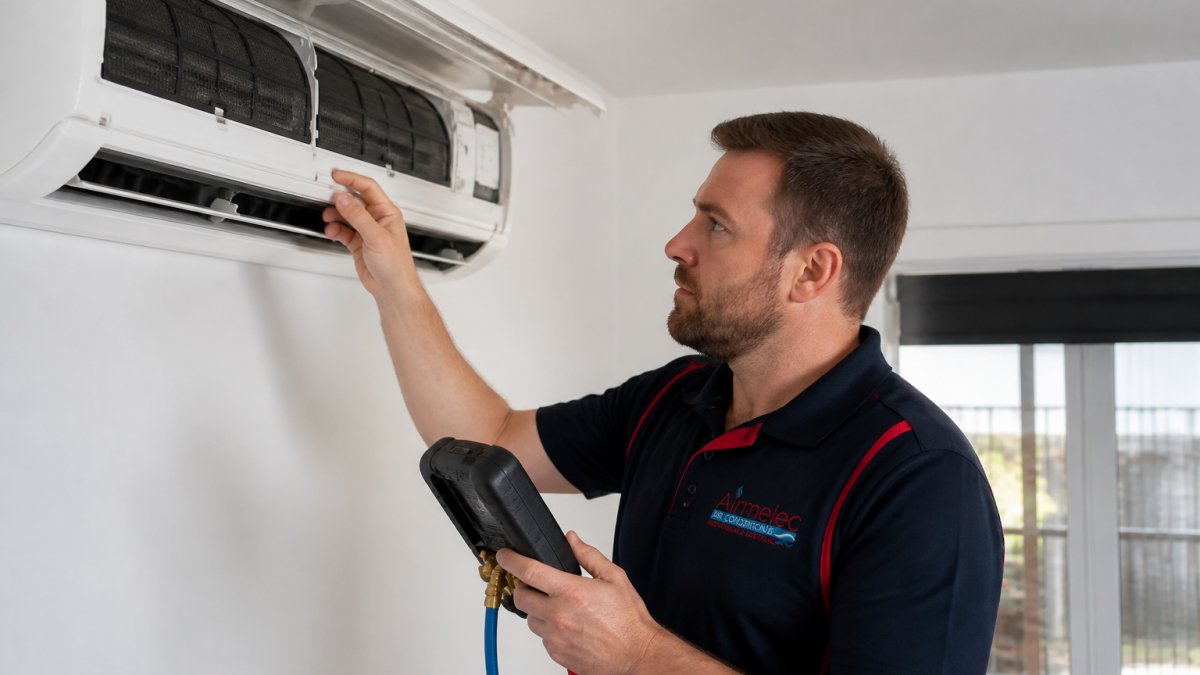
A professional technician arrives in a clearly marked, branded vehicle with proper tools and diagnostic equipment, not improvised solutions. They’ll explain what they’re doing, answer questions, and provide written documentation of completed work.
Ask for references from recent jobs in your area. Speak directly with previous customers about their experience. A contractor confident in their work will provide this without hesitation.
Verify reviews across multiple platforms, but treat extreme ratings (all five stars or all one star) with scepticism.
Ask about insurance and guarantees.
How to Choose the Right Alternative for Your Home
Your choice depends on matching contractor capabilities to your specific situation.
For emergency repairs: Prioritise rapid response times and 24/7 availability.
For new installations: Choose a contractor experienced with your preferred system type and property configuration.
For routine maintenance: Look for annual service plans with fixed pricing, which removes uncertainty and ensures regular professional attention.
Compare at least three contractors.
| Evaluation Criterion | What to Look For | Why It Matters |
|---|---|---|
| Licencing | Current, verifiable credentials | Safety and legal compliance |
| Response Time | Same-day or next-day availability | Minimises discomfort during emergencies |
| Financing Options | Interest-free plans or rebate eligibility | Reduces upfront cost burden |
| Warranty Coverage | Written warranties on parts and labour | Protects your investment long-term |
| References | Verified customer feedback and reviews | Indicates reliability and quality |
| Insurance | Current public liability coverage | Protects you from liability if damage occurs |
Finding the right air conditioning contractor means balancing cost against reliability, speed against thoroughness, and immediate need against long-term value.
Air Conditioning & Electrical brings together the qualities that matter most: fully licensed technicians, flexible financing through Brighte’s 0% interest plans, and participation in NSW Government’s Home Energy Saver loan program.
Frequently Asked Questions
How do I compare air conditioning contractors to find the best alternative?
Start by verifying each contractor holds current licences and qualifications for refrigeration work. Check their service area coverage, response times for emergencies, and whether they offer financing options. Ask for references from recent installations and maintenance jobs. Compare what’s included in their service packages, some contractors provide comprehensive maintenance plans whilst others charge per visit. Request quotes from multiple providers to understand pricing structures, though remember that the cheapest option isn’t always the best value.
What should I check before choosing an air conditioning installer?
Confirm the installer holds proper licencing under relevant refrigeration and electrical standards. Ask about their experience with your property type and cooling system preference. Verify they provide written quotes with installation timelines and warranty details. Check whether they handle post-installation support and maintenance. Ask if they’re approved for government energy efficiency programmes that might reduce your upfront costs. Get clarity on their emergency repair availability, especially during summer months when breakdowns are common.
How can I tell whether an air conditioning technician is properly licensed?
Request their licence number and verify it through the relevant regulatory body. Licensed technicians should carry current credentials and be happy to provide proof. Ask about their refrigeration qualifications and any additional certifications for electrical work if your installation involves both systems. Check whether they’re registered with professional bodies in their field. Legitimate contractors won’t hesitate to discuss their qualifications, this is a red flag if they avoid the question or can’t provide documentation.
What should an air conditioning maintenance service include?
A comprehensive maintenance visit should cover cleaning or replacing filters, checking refrigerant levels, inspecting electrical connections, testing system controls, and cleaning indoor and outdoor coils. The technician should verify the system is operating at peak efficiency and identify any worn components before they fail. Good maintenance services include a written report of findings and recommendations for any repairs needed. Regular maintenance typically happens before summer and can catch problems early, preventing expensive breakdowns during peak cooling season.