
Table of Contents
- Energy-Efficient Cooling Solutions That Lower Running Costs
- Reverse-Cycle Air Conditioners and Heat Pumps
- Split-System Air Conditioners for Targeted Cooling
- Evaporative Cooling for Dry Climates
- How to Reduce Air-Conditioning Energy Use
- Passive Cooling Strategies to Minimise Reliance on Systems
- Understanding Air Conditioner Energy Rating and Efficiency
- How to Size an Air Conditioner for a Room
- Frequently Asked Questions
Last Updated: October 18, 2026
Energy-Efficient Cooling Solutions That Lower Running Costs
When your electricity bill climbs each summer, the air conditioner is often the culprit, but replacing it entirely isn’t your only option. At Air Conditioning & Electrical, we help homeowners stay cool without letting power consumption spiral by recommending energy efficient cooling solutions. Several proven approaches can significantly reduce cooling costs.
Energy efficient cooling solutions range from modern heat pumps to passive design strategies that cost nothing to implement. The right choice depends on your climate, home layout, budget and willingness to change daily habits. Here’s how each major option works.
Quick Comparison of Cooling System Types
| Cooling Type | Energy Use | Best Climate | Installation Cost | Maintenance |
|---|---|---|---|---|
| Reverse-cycle air conditioner | Low to moderate | All regions | Moderate | Annual service |
| Split-system air conditioner | Moderate | All regions | Moderate | Annual service |
| Evaporative cooling | Very low | Dry climates | Low | Seasonal cleaning |
| Passive strategies | None | All regions | Minimal | Ongoing habits |
| Portable air conditioner | High | Small spaces | None | Filter cleaning |
Reverse-Cycle Air Conditioners and Heat Pumps
A reverse-cycle air conditioner is a heat pump that cools in summer and heats in winter using the same unit, making it one of the most energy-efficient cooling solutions if you also need heating.
Reverse-cycle units work by extracting heat from outside air (even on cool days) and transferring it indoors or vice versa.
When sizing a reverse-cycle system, consider the room’s square metres, insulation quality and daily run time. An undersized unit runs constantly and consumes more energy; an oversized one cycles on and off inefficiently. Air Conditioning & Electrical can calculate the right capacity for your space.
Split-System Air Conditioners for Targeted Cooling
Split-system air conditioners consist of an indoor unit mounted on a wall or ceiling and an outdoor compressor connected by refrigerant lines. They cool specific rooms without conditioning the whole house, saving energy compared to ducted systems running all day.
The key advantage: you only cool the spaces you’re using. Close doors to unused rooms, set the thermostat to 24-26°C, and the system delivers targeted cooling where needed.
Energy ratings on split systems typically range from 3 to 6 stars. Higher-rated units deliver more cooling per kilowatt-hour of electricity.
Evaporative Cooling for Dry Climates
Evaporative cooling works on a simple principle: as water evaporates, it absorbs heat from the air. With only a fan and small water pump powered, electricity demand is a fraction of a compressor-based air conditioner‘s.
The catch is humidity. Evaporative cooling performs well when outdoor relative humidity stays below about 40-50% during the hottest part of the day, and becomes progressively less effective as humidity rises. In humid coastal conditions the air is already near saturation, so evaporation slows and delivered cooling drops sharply, the system then just moves warm, damp air.
Matching the technology to climate zone
The National Construction Code climate zone map divides the country into eight zones, and evaporative suitability tracks them closely:
- Hot dry and hot arid zones (inland areas): the strongest fit. Low humidity and high summer temperatures mean evaporative systems deliver comfortable cooling at very low running cost.
- Warm temperate and temperate zones: workable in summer, especially on the drier days, but performance varies through the season.
- Hot humid and warm humid zones (coastal and tropical): generally unsuitable as a primary cooling system because of persistent high humidity.
- Cool and alpine zones: limited summer cooling demand; the economics rarely justify a dedicated system.
Installers often recommend a hybrid approach in marginal climates: evaporative cooling for the dry shoulder season and a reverse-cycle unit for humid spells. It costs more upfront but avoids relying on evaporative cooling in a humid week.
Running cost mechanics
Because evaporative cooling uses a fan motor and pump rather than a compressor, its electricity draw is typically a few hundred watts to about 1.5 kW for a whole-home ducted unit, depending on fan speed and size. A reverse-cycle system of similar capacity may draw several kilowatts while the compressor runs. In a suitable climate, evaporative cooling can cut cooling electricity use by a large margin.
Water use is the other side of the ledger. Evaporative systems consume water continuously while running, which can be decisive in drought-affected or restricted areas. Check local water authority guidance before committing.
Maintenance and lifespan
Evaporative cooling is mechanically simple but not maintenance-free. A practical schedule:
- Start of season: replace or clean the filter pads, flush the water tank, check the pump and bleed-off rate, and clear the distribution ducts.
- Monthly in season: inspect pads for scale and algae, and check the water level.
- End of season: drain the system, clean the tank, and cover the outdoor unit.
With that routine, a well-installed ducted evaporative system commonly lasts 15-20 years, with no refrigerant circuit to leak or compressor to fail.
Evaporative cooling is one of the lowest-running-cost options available, but only where summer humidity stays low. Confirm your climate zone and local water rules before choosing it as your primary system.
How to Reduce Air-Conditioning Energy Use
Even the most efficient air conditioner wastes energy if operated poorly. Simple habit changes can cut cooling costs without sacrificing comfort.
Set your thermostat to 24-26°C. Each degree lower increases energy consumption. Most people feel comfortable in this range, especially with air movement from ceiling fans.
Close doors and vents in unused rooms. Sealing off bedrooms and storage spaces when cooling only the living areas reduces energy waste.
Use ceiling fans alongside air conditioning. Fans circulate cool air, letting you set the thermostat slightly higher while staying comfortable, and use a fraction of the electricity.
Service your system annually. A dirty filter or low refrigerant charge forces the air conditioner to work harder and consume more energy.
Avoid cooling when you’re away. Program the system to turn off during work hours or holidays; smart thermostats can learn your schedule and adjust automatically.
Passive Cooling Strategies to Minimise Reliance on Systems
The most energy-efficient cooling is the cooling you don’t use. Passive design reduces indoor temperatures naturally, cutting reliance on air conditioning.
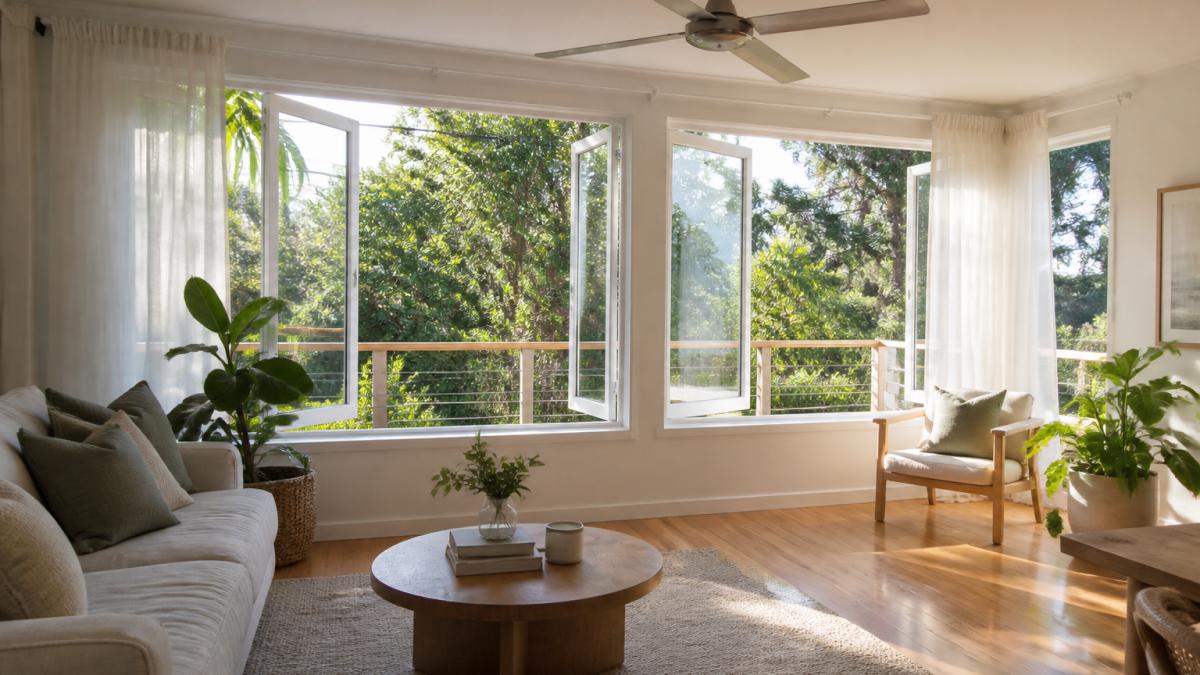
Cross-ventilation is your first tool. Open windows on opposite sides of your home to create airflow that removes heat.
Shade your windows. External shading such as awnings, shutters or shade sails blocks solar heat before it enters.
Improve insulation. Proper roof and wall insulation slows heat transfer into your home. Older houses often have little or none; upgrading reduces cooling demand significantly and pays dividends year after year.
Use light-coloured roofing and walls. Dark surfaces absorb heat; light colours reflect it.
Plant trees strategically. Deciduous trees on the western and northern sides provide summer shade and let winter sun through when leaves drop, a long-term but effective solution.
Minimise heat-generating appliances during the day. Cooking, laundry and dishwashing all generate heat; run them in the early morning or evening.
Understanding Air Conditioner Energy Rating and Efficiency
Energy ratings tell you how efficiently an air conditioner converts electricity into cooling. More stars equal lower running costs, a 6-star unit is significantly more efficient than a 3-star model.
The rating accounts for cooling capacity (in kilowatts) and the energy input required. A low-capacity unit with a low rating may struggle to cool adequately and run constantly, wasting energy.
When comparing air conditioners, check the energy rating label, which shows an annual running cost estimate based on typical usage. Higher-rated units cost more upfront but often repay the premium through reduced electricity bills.
How to Size an Air Conditioner for a Room
Sizing is where most cooling mistakes are made. An undersized unit runs near-continuously on hot days, never quite reaches setpoint and wears out faster. An oversized unit short-cycles, starting and stopping repeatedly, wasting energy on startup, removing less humidity and creating uneven temperatures. Getting capacity right is the biggest determinant of comfort and running cost.
The rule-of-thumb starting point
A rough first estimate uses room volume: length × width × height in metres. A 4 m × 5 m × 2.7 m room gives 54 cubic metres; at roughly 100-150 watts of cooling capacity per cubic metre, that suggests about 5.4-8.1 kW. Treat this as a sanity check, not a specification, it ignores almost everything that matters.
What the rule of thumb misses
A proper load calculation accounts for the factors below, and each one can shift the required capacity by a meaningful margin:
- Climate zone. The National Construction Code climate zone map sets design conditions. A hot arid inland location needs more capacity per square metre than a cool temperate coastal one.
- Insulation and thermal performance. A well-insulated home with ceiling, wall and floor insulation and draught sealing needs less capacity than an older, leaky house of the same size.
- Glazing and orientation. Large west- and north-facing windows without external shading drive significant heat gain. Single glazing performs far worse than double glazing. External shading is more effective than internal blinds.
- Occupancy and internal loads. Kitchens, home offices with multiple screens, and rooms with many occupants generate heat that must be removed.
- Ceiling height and layout. High ceilings and open-plan spaces need more capacity than standard-height, partitioned rooms.
Installation considerations that affect performance
Capacity is only half the story; where and how the unit is installed matters just as much.
- Indoor unit position. Mount the head high on a wall where airflow reaches the whole room, not blowing directly onto seating. Avoid positions above heat sources or in dead corners.
- Outdoor unit placement. The compressor needs clear airflow and shade where possible. Cramped, sun-baked or enclosed positions reduce efficiency and shorten equipment life.
- Refrigerant pipe runs. Long pipe runs between indoor and outdoor units reduce capacity and efficiency; keep them as short as practical.
- Drainage. Condensate must drain to a suitable point; poor drainage causes water damage and callbacks.
- Electrical supply. Confirm the circuit and switchboard can support the unit; older homes may need an upgrade.
Why a professional load calculation matters
A qualified installer will run a room-by-room load calculation rather than relying on a rule of thumb, accounting for your actual insulation, glazing, orientation, climate zone and usage pattern. It also identifies whether a single split system, multi-head system or ducted solution best fits your layout. A proper assessment costs little relative to installing the wrong system and living with it for a decade.
Do not accept a quote based purely on floor area. A capacity figure without a load calculation is a guess, and oversized systems are one of the most common causes of poor humidity control and higher-than-expected running costs.
Frequently Asked Questions
What is the most energy-efficient way to cool a home?
Reverse-cycle air conditioners (heat pumps) are among the most energy-efficient cooling solutions, converting ambient heat rather than generating cold. In dry climates, evaporative cooling can use 80-90% less electricity than reverse-cycle systems. Combining mechanical cooling with passive strategies, insulation, shading, ventilation, and strategic window placement, reduces overall energy consumption further. The best approach depends on your climate, home layout, and usage patterns.
How can I make my air conditioner more energy-efficient?
Set your thermostat 1-2 degrees higher than your comfort minimum, use ceiling fans to circulate cool air, keep filters clean, ensure proper system sizing, and schedule regular maintenance. Close doors to unused rooms and use window coverings to block heat during the day. Seal air leaks around windows and doors. If your system is older, a newer energy-efficient model with a higher efficiency rating will deliver greater savings than behavioural adjustments alone.
Which type of air conditioner uses the least electricity?
Reverse-cycle split-system air conditioners with high energy ratings use significantly less electricity than older cooling-only models. Evaporative cooling systems consume even less power in suitable climates. To compare running costs and efficiency, use the government’s Energy Rating Calculator, which shows estimated annual electricity usage for specific models. Inverter-driven systems adjust capacity dynamically and consume less energy than fixed-speed compressors.
How does passive cooling work?
Passive cooling harnesses natural airflow, thermal mass, shading, and insulation to maintain comfort without mechanical systems. Cross-ventilation through strategically opened windows removes heat. High-quality insulation and reflective glazing reduce heat gain. External shading (trees, awnings, shutters) blocks solar radiation before it enters the home. Thermal mass (concrete, brick) absorbs heat during the day and releases it at night. These strategies reduce reliance on air conditioning and lower energy consumption.
What should I consider when choosing an energy-efficient cooling system?
Evaluate your climate (dry or humid), room size and layout, existing insulation, budget, and long-term occupancy plans. Reverse-cycle systems suit most climates; evaporative coolers work best in dry regions. Check the energy star rating and compare estimated running costs using the Energy Rating Calculator. Consider installation complexity, maintenance requirements, and whether you need whole-home or targeted cooling. Professional sizing ensures the system matches your space, oversized units waste energy; undersized ones run constantly.